APOPKA, FL · HOME REPAIR & RESTORATIONExplore Apopka service area
Home Services ApopkaCall (407) 469-7577 ↗
Appliance Repair · Apopka, FL

Dishwasher Repair in Apopka, FL

A dishwasher that leaves grit on every glass isn't saving you time — it's making more work. And a dishwasher that leaks doesn't announce itself; you find it when the cabinet base swells or the floor buckles. We trace dishwasher problems along the water path: fill, wash, drain. A machine that won't drain, a door that leaks at the corners, a load that never gets hot — each symptom narrows the fault before we quote anything. For dishwasher repair near me in Apopka, the right next step depends on the symptoms — this page explains what to check and what to ask about.

Emergency service and 24/7 availability — call to confirm timing for your address.

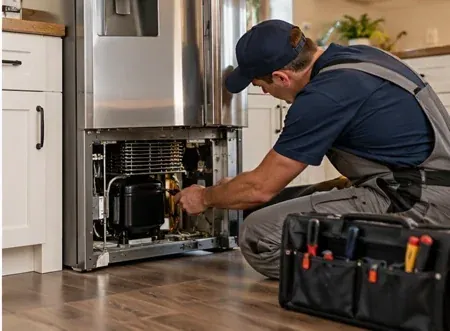
Technician diagnosing a dishwasher that stopped draining in an Apopka, FL kitchen
Dishwasher Repair · Apopka, FL
⌖ Apopka, FloridaCall about this serviceReview the scope before approving work
The moment it's worth calling

Which pattern matches your dishwasher?

01 / Symptom

Won't drain — standing water at the bottom after the cycle

When you call us about a dishwasher that won't drain, the first thing we ask is whether the disposal was recently replaced — a disposal installed without knocking out the drain plug blocks the dishwasher completely, and we see it constantly in Apopka's newer homes. Otherwise we check the filter and sump for food buildup, then the drain hose for a kink or clog. A pump that hums without moving water is a different answer than a silent one, so tell us what you hear when the drain cycle runs.

02 / Symptom

Leaking at the door, or water on the floor after a run

Water at the front corners usually means the door gasket has flattened or the spray arm is cracked and throwing water sideways at the seal. Water under the sink points at the inlet valve or the supply connection instead. Either way, close the shutoff valve under the sink first, then mop up — a slow leak soaks the cabinet base before you ever see a puddle, and in Florida humidity that base swells and grows mold within days. Note where the water appears and when: during fill, during wash, or only at the end.

03 / Symptom

Dishes come out dirty, gritty, or spotted

Grit on every glass is a spray problem, not a detergent problem. We check the spray-arm jets for scale — Apopka's hard water closes them up over time — then the filter, then whether the water is actually getting hot. A dishwasher that fills and drains but never heats leaves grease on everything, and that points at the heating element or its thermostat. And check the racks: overloading blocks the spray pattern, so the top rack comes out dirty while the bottom looks fine. The pattern tells us where to look.

04 / Symptom

Won't start, stops mid-cycle, or hums without filling

A panel that lights up but does nothing is usually the door switch or latch — the machine thinks the door is open. A hum with no fill is the inlet valve straining against low pressure or scale, the same hard-water story as the spray arms. A machine that stops mid-cycle and flashes an error code is often the drain system: it can't empty, so it won't advance. Tell us the error code if one shows, and whether it followed a storm — a dark panel after lightning is a control-board call.

Understand the work

What dishwasher service covers — and what it doesn't

  • Drain system repair. Drain-pump testing and replacement, drain-hose clearing and rerouting, filter and sump cleaning, and the garbage-disposal knockout-plug check that fixes so many no-drain calls.
  • Fill system repair. Inlet-valve testing and replacement, float-switch checks, and water-supply verification at the shutoff under the sink — including scale diagnosis from Apopka's hard water.
  • Wash system repair. Spray-arm cleaning and replacement, circulation-pump testing, and filter service. We check water temperature at the fill, because a wash that never gets hot can't clean.
  • Heating and drying. Heating-element continuity testing, thermostat replacement, and rinse-aid and drying diagnosis for dishes that come out wet or spotted.
  • Door, latch, racks, and controls. Door-gasket replacement, latch and door-switch repair, rack-wheel and tine repair, and control-board diagnosis for dead panels and mid-cycle stops.
  • What's out of scope. Cabinet or countertop modification to fit a new dishwasher, water damage restoration when a leak already reached floors or drywall — see our water damage restoration page for that — and whole-dishwasher replacement guidance, which our appliance repair hub covers with the repair-or-replace math. The hub also links to our refrigerator repair and oven / range repair pages.

That's the scope. The question underneath it is timing — and with a leak, timing is measured in cabinet wood, not just parts.

Cost of waiting

What waiting does to a dishwasher — the mechanisms, not the fear

A small leak becomes a cabinet job

A small leak becomes a cabinet job A door gasket that weeps a spoonful per cycle never shows a puddle — it wicks straight into the particleboard cabinet base, which swells, delaminates, and grows mold in Florida humidity within days. What starts as a gasket becomes a cabinet base, a toe-kick, and a drying conversation. The leak you can't see is the one that costs the most.

Standing water turns on the machine

Standing water turns on the machine A drain fault left alone doesn't stay a drain fault: dirty water sitting in the sump breeds odor and biofilm, the drain pump burns out running against a blocked hose, and the circulation pump seizes from the grit that settles instead of flushing. One clogged filter becomes two dead pumps — and a pump that runs dry is a pump that doesn't get repaired, it gets replaced.

None of this is panic. It just means a leaking or non-draining dishwasher is a this-week decision, not a next-month one — we tell every caller that.

Three checks before the work starts

  • Water plus electricity

    A dishwasher leaking near outlets or the disposal switch is a shock risk — we treat it that way on every call. If water reached an outlet, don't unplug anything with wet hands; kill the breaker from a dry spot first.

  • Shut the water off before the machine comes out

    Close the hot-water shutoff under the kitchen sink before anyone pulls the dishwasher from its bay — the supply line is pressurized even when the machine is off, and a pulled hose floods a kitchen in seconds.

  • Don't run a leaking dishwasher, and never pour in drain cleaner

    Running a machine that leaks only spreads the water further under the cabinets. And drain cleaner eats the rubber seals, hoses, and pump parts it touches — it turns a clogged drain into a full seal replacement.

Apopka specifics

Why Apopka is hard on dishwashers

Hard water leaves its mark on every cycle

Apopka's water comes from the Floridan Aquifer, and it's mineral-heavy — worse in the dry season. Every fill lays a little scale on the heating element and inside the spray-arm jets, and over a year or two the jets close up and the element runs hotter under its own crust. White film on glasses is the visible warning; the invisible one is the element working harder and the pump pushing against narrowing jets. We descale and check the element on every visit, because a valve or element swapped without addressing the water fails again on the same schedule.

Humidity turns a small leak into a mold call

A slow door-gasket leak in a dry climate dries out. In Apopka it doesn't — summer humidity keeps the cabinet base damp around the clock, and particleboard swells and grows mold within days of staying wet. Homes near Lake Apopka and the Wekiva Springs side of town, where the air stays heaviest, show it fastest. That's why we treat any dampness under the sink as urgent even when the puddle looks small: the cabinet is already telling you the leak is older than it looks.

Storms, surges, and the disposal connection

Two Apopka patterns we see nowhere else as often. First, the daily summer thunderstorms rolling off Lake Apopka knock out dishwasher control boards — dark panel, dead machine, right after lightning. Second, the disposal knockout plug: the newer subdivisions off Kelly Park Road, US-441, and the State Road 429 corridor have had waves of disposal swaps, and a skipped knockout plug leaves the dishwasher with nowhere to drain. Same town, two different signatures, and the age of the kitchen tells us which to check first.

How the job runs

What happens during a dishwasher service visit

  1. Verify the symptom with instruments

    We run a short cycle and watch it: fill level, water temperature at the fill, spray pressure, and whether the drain empties fully. A drain pump humming without moving water is a very different answer than one that never gets power — our instruments decide, not guesses.

  2. Isolate the system

    Fill, wash, drain, or heat — we narrow to one system before naming any part. That's what separates our diagnosis from parts-swapping: we identify the failed part, we don't assume it.

  3. Scope in writing

    Then we lay it out: the failed part, whether it's on our truck or ordered, and what changes the scope — a cracked tub or a control-board finding changes the conversation to the repair-or-replace math on our appliance repair hub. You approve before anything comes apart.

  4. Repair and verify

    Part replaced, filter cleaned, spray arms cleared — then we run a full cycle and verify: complete drain, no leaks at the door or under the sink, and hot water at the wash, before we leave, not just "it sounds better."

Before you call

Call now, or can it wait? — and what to have ready

Call now

  • water actively leaking onto the floor or into the cabinet base
  • the dishwasher overflows during a cycle
  • a burning smell or repeated breaker trips at the dishwasher circuit
  • standing water that won't drain after a full cycle

Can wait for a scheduled visit

  • spots or white film on glasses with normal draining
  • a noisy drain pump that still empties the tub
  • a broken rack wheel or tine
  • a door latch that feels stiff but still seals

What to have ready

  1. The machine. Brand, model number (on the door edge or the tub wall), and approximate age. Age feeds the repair-or-replace decision on the hub page.
  2. The symptom. Which stage fails — fill, wash, drain, or dry — and what it does instead: hums, leaks at the door, stops mid-cycle, or leaves grit behind.
  3. The history. Whether a garbage disposal was recently replaced (the knockout plug is the first thing we check), whether it followed a storm, and any error code on the display.

Call made. Here's what the visit itself looks like, so there are no surprises.

During the visit

What to expect while the repair is underway

  1. Diagnosis first, then repair

    We pull the dishwasher partway from its bay — clear the space in front of it and move anything stored under the sink. Most of the first visit is diagnosis: a test cycle, filter and sump inspection, drain-path checks, and water-temperature readings. Pumps, inlet valves, and latches are usually on the truck and fixed the same visit; control boards we usually order — ask us upfront which one you're in for. Expect some water on towels and floor protection while we work, and a full test cycle at the end with the door closed. Before we leave: ask what we replaced, whether the drain emptied fully, and what to watch for in the next few loads. We put it in writing — parts and labor itemized.

Homeowners often ask how these jobs connect, because one problem in an Apopka home rarely travels alone. Standing water over a silent disposal points to a look at your under-sink disposal unit rather than a drain problem alone. An oven that runs hot on one side and cool on the other is a standard call for oven and range repair in Apopka.

Helpful answers

What Dishwasher repair typically costs in Apopka

Our diagnostic visit runs from $70. Most dishwasher repairs start from $160. The confirmed price comes only on the call or at inspection time.

ServiceTypical starting price
Diagnostic visitfrom $70
Dishwasher repair (typical)from $160
Most appliance repairs overallfrom $100

Every problem's work and cost is different — The confirmed price comes only on the call or at inspection time. Starting prices below are typical, not fixed prices.

Dishwasher Repair FAQs

Why won't my dishwasher drain?

Standing water means the drain path is blocked, not that the pump has died. We check the filter and sump, then the drain hose for kinks or clogs, then the garbage disposal — a disposal installed without knocking out the drain plug is a classic cause in newer Apopka homes. If the path is clear and the pump hums without moving water, the pump is the fault. We test in that order, so you don't pay for an unneeded pump.

My dishwasher is leaking. What should I do first?

Stop the cycle, then close the water shutoff valve under the kitchen sink — most dishwashers share the sink's hot-water supply. Mop up standing water and pull out anything stored under the sink, because a slow leak soaks cabinet bases fast in Florida humidity. Don't run the machine again until the source is found: door gasket, spray-arm seal, inlet valve, or a cracked tub. If water reached the subfloor, drying matters too — see our water damage restoration page.

Why are my dishes still dirty after a full cycle?

Dirty dishes trace to water not reaching them, not to the detergent. We check the spray arms for clogged jets — Apopka's hard water scales them shut — then the filter, the fill temperature, and whether the circulation pump pushes with full pressure. Overloading the racks blocks the spray pattern too. A dishwasher that fills and drains but never heats the water enough leaves grease behind on every load, and that points at the heating element.

Is it worth repairing my dishwasher, or should I replace it?

We use the same 50% guide as our appliance repair hub: if the repair costs less than half of a comparable new dishwasher, repair usually wins. Pumps, inlet valves, latches, and spray arms are routine fixes on machines under ten years old. A failed control board or a cracked tub on an older unit is harder to justify, and a machine that leaks from the tub itself is usually done. We give you the numbers before any work starts.

Why does my dishwasher smell bad?

The smell comes from food and grease trapped where water doesn't flush — the filter, the sump, and the door gasket folds. We clean the filter, clear the sump, wipe the gasket channel, then run a hot empty cycle. If the smell returns, the drain hose may sag and hold dirty water, or the machine isn't heating enough to dissolve grease. A dishwasher that still smells after cleaning has a drainage or heating fault underneath, not a detergent problem.

My dishwasher won't start at all. What should I check?

First check the obvious: door latched, cycle selected, breaker not tripped — a dishwasher shares a circuit with the disposal in many Apopka kitchens, and a jam can trip it. If the panel lights up but nothing happens, the door switch or latch is the suspect. If the panel is dark after a storm, the control board may have taken a surge. Tell us what the panel shows and whether it followed a storm; that steers the diagnosis.

We just replaced the garbage disposal and now the dishwasher won't drain. Why?

This is the most common call we get after a disposal swap. The disposal's dishwasher inlet has a plastic knockout plug that must be removed before the drain hose is connected — if the installer skipped it, the dishwasher has nowhere to drain. The fix is quick: disconnect the hose, knock the plug out, reconnect, and test a drain cycle. We see it in newer homes across Apopka, and it's a ten-minute correction once you know to look for it.

Is there dishwasher repair near me in Apopka?

Yes — we serve homes across Apopka, from downtown and the Lake Apopka shoreline to the newer neighborhoods off Kelly Park Road and State Road 429, and the number on this page connects you with the team that handles dishwasher repair for your address. Confirm availability and timing when you call.

Further reading

Sources and technical references

View supporting references and safety sources
  1. Florida Building Code — Plumbing

    Dishwasher drain-connection rules, including the air-gap / high-loop requirement and the garbage-disposal drain connection.

  2. NSF/ANSI 184 — Residential Dishwashers

    Performance standard for residential dishwashers, including soil-removal and sanitization requirements for wash cycles.

  3. U.S. Environmental Protection Agency (EPA) WaterSense

    Water-use guidance for dishwashers and the water-efficiency context for fill and rinse design.

  4. Manufacturer use-and-care manuals

    Model-specific diagnostics, filter-cleaning intervals, error codes, and drain-hose routing for your dishwasher.

A dishwasher that leaks or drains poorly creates exactly the warm, damp, food-scented space that pests move into, so the machine is only half the story. Roaches nesting behind the kick plate or in the insulation will keep reappearing until someone deals with the rodents and roaches using the kitchen as shelter — droppings or gnawed hoses behind the unit are the giveaway. If the infestation is active and spreading through the cabinets, that stops being a routine visit and becomes an emergency pest call before the next dishwasher cycle pushes more water into the void. The laundry pair often shares the same drain and supply habits, so a home fighting dishwasher drainage trouble frequently has a washer that is starting to drain slowly as well. And when one built-in kitchen machine is down, it is worth checking the microwave mounted above the range, since the two often share a circuit and the same surge exposure.

Before scheduling the repair: Review the estimate details and consider whether the problem needs professional attention now.

When to call a home professional ↗ How to compare home service estimates ↗

When to call a home professional — the call-now vs. wait decision framework, generalized across every trade.

How to compare home service estimates — what a real appliance quote contains, and the red flags that matter on sealed-system jobs.

Need Dishwasher Repair in Apopka, FL?

Before authorizing work, ask about diagnosis fees, likely parts availability and whether repair is practical. Call the service number to confirm service coverage and appointment availability.

Apopka, FLDishwasher Repair ☎ (407) 469-7577