APOPKA, FL · HOME REPAIR & RESTORATIONExplore Apopka service area
Home Services ApopkaCall (407) 469-7577 ↗
Appliance Repair · Apopka, FL

Oven & Range Repair in Apopka, FL

An oven that won't heat ruins the plan for dinner — and a burner that clicks without lighting is worse, because now you're wondering about gas. We read ovens the way we read every appliance: the symptom first, the part second. A cold oven with a glowing igniter, a burner that sparks but never catches, a temperature that's far off the dial — each one points somewhere specific, and we'll tell you where before we quote anything. For oven / range repair near me in Apopka, the right next step depends on the symptoms — this page explains what to check and what to ask about.

Emergency service and 24/7 availability — call to confirm timing for your address.

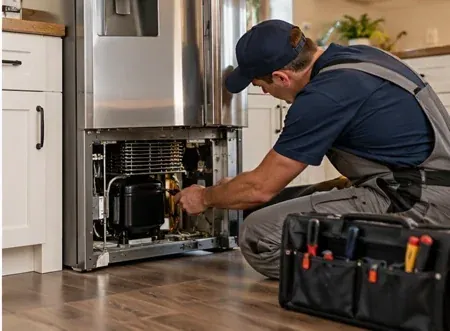
Technician diagnosing an oven that stopped heating in an Apopka, FL kitchen
Oven / Range Repair · Apopka, FL
⌖ Apopka, FloridaCall about this serviceReview the scope before approving work
The moment it's worth calling

Which pattern matches your oven or range?

01 / Symptom

Oven won't heat, or heats far below the set temperature

When you call us about a cold oven, the first thing we ask is what the igniter or element is doing. Gas oven glowing orange but never lighting? The igniter is weak — it glows without drawing enough current to open the gas valve. Electric oven stone cold? We test the bake element for continuity before anything else. And if the oven heats but never reaches temperature, the sensor may be lying to the board. Note whether the broiler works — a working broiler with a dead bake circuit narrows the fault fast.

02 / Symptom

A burner clicks and clicks but never lights

Constant clicking with no flame is usually a spark problem, not a gas problem. On a gas cooktop we check the burner cap seating first — a cap set crooked after cleaning throws the spark off the gas stream — then the igniter electrode and the spark module. Boil-overs leave food and moisture in the burner ports, and a clogged port won't carry flame even with a good spark. If you smell gas while it clicks, stop trying: turn the burner off and ventilate before you call us.

03 / Symptom

Oven runs hot, burns everything, or shuts off mid-bake

An oven that runs 50 degrees over the dial is usually a temperature sensor that has drifted — it reports a cooler temperature than the oven really holds, so the board keeps heating. Shutting off mid-bake is a different trail: a thermal fuse or high-limit thermostat tripping because heat is building up where it shouldn't, often from a blocked vent or a failed cooling fan. Tell us whether the display stays lit when it cuts out — that one detail separates a sensor fault from a board fault.

04 / Symptom

Burning smell, smoke, or the breaker trips when the oven runs

A burning smell on first use after months idle is often just dust on the element — but a smell that returns every bake, or smoke from the control panel area, means stop and call. Electric ranges draw heavy current, and a loose connection at the terminal block or a scorched wire will trip the breaker and scorch the insulation around it. Don't reset a tripped oven breaker more than once; repeated trips are the circuit telling you something is failing, and we would rather find it cold than find it after a fire.

Understand the work

What oven and range service covers — and what it doesn't

  • Igniter and heating-element repair. Gas igniter amp-draw testing and replacement, bake and broil element continuity testing and replacement — the fix for most cold-oven calls.
  • Burner and cooktop service. Spark electrodes, spark modules, burner caps and ports, infinite switches, and gas burner valves. We clean and reseat before we replace.
  • Temperature sensors and thermostats. Sensor resistance testing against the manufacturer's chart, thermostat replacement, and oven temperature verification with a thermometer on the middle rack.
  • Control boards, timers, and displays. Electronic diagnosis for erratic temperatures, dead displays, and post-storm failures; board replacement where the board is the fault, not the symptom.
  • Door hinges, gaskets, and latches. Hinge and spring replacement, door gasket replacement for heat leaks, and self-clean latch repair — a door that won't seal makes the whole oven work harder.
  • What's out of scope. Gas supply-line installation or relocation, countertop or cabinetry modification for a new range, and whole-range replacement — for the repair-or-replace math, our appliance repair hub walks through it. If more than one kitchen appliance is acting up, the hub also links to our refrigerator repair and washer-dryer repair pages.

That's the scope. The question underneath it is timing — and with a gas range, timing is a safety question, not just a convenience one.

Cost of waiting

What waiting does to an oven or range — the mechanisms, not the fear

The igniter's slow death

The igniter's slow death A gas igniter doesn't usually fail all at once — it weakens over months, drawing less and less current, taking longer to light, until one day it glows and nothing happens. Every slow light dumps a little unburned gas into the cavity first. Catch it while it still lights and it's a small part; wait until it quits and you're cooking nothing until the part arrives.

Heat damage spreads

Heat damage spreads An oven running hot because of a drifting sensor doesn't just burn dinner — it bakes its own control board, the wiring above the door, and the cabinetry around it, a little more every week. A door gasket leaking heat does the same work from the edges. The sensor is a small part; the board it cooks is not, and boards for older ranges go out of stock while you wait.

None of this is panic. It just means a range that misbehaves is a this-week decision, not a next-month one — we tell every caller that.

Three checks before the work starts

  • If you smell gas, leave first

    Don't flip switches, don't light anything, don't keep trying the igniter. Leave the house and call your gas utility or emergency services from outside. A gas smell plus a clicking igniter is the one oven symptom we never ask you to investigate yourself.

  • Kill the power before touching anything

    An electric range runs on a 240-volt circuit — turn the breaker off before pulling the range out or touching the terminal block. Capacitors on the control board can hold a charge after unplugging, so we leave the board to people with the tools.

  • Don't force a self-clean cycle on a failing oven

    Self-clean runs hotter than any bake cycle. On an oven with a drifting sensor, a failing fan, or a worn gasket, that extra heat is what finishes off the control board — or trips the thermal fuse mid-cycle with the door locked. Tell us the oven is misbehaving before anyone runs self-clean.

Apopka specifics

Why Apopka is hard on ovens and ranges

Summer heat works the control board twice as hard

Apopka kitchens run hot from May through September — high 80s and low 90s indoors in older block homes near downtown Apopka and Park Avenue with small kitchens and weak ventilation. Control boards are built for cooler rooms, and every bake cycle in that heat ages their solder joints a little faster. Add a self-clean cycle in August and the board is cooking itself. We see more dead displays and erratic temperatures here in late summer than in any other season.

Afternoon storms and the surge problem

Central Florida leads the nation in lightning, and the daily summer thunderstorms rolling off Lake Apopka take out more oven control boards than any other single cause. The pattern is always the same: lights on, display dead or frozen, right after a storm. Homes along the Wekiva Springs side of town and the newer subdivisions off Kelly Park Road and State Road 429 see it just as often as the older streets — a surge doesn't care how new the range is.

Old ranges in old Apopka kitchens

Many 1960s- to 1980s-era homes around downtown Apopka still run their original electric ranges on wiring that has baked behind the wall for decades — loose terminal-block connections and scorched insulation are the failures we find there. The newer gas ranges in subdivisions off US-441 and the 429 corridor fail differently: igniters weakened by years of boil-overs and burner ports clogged with cooking grease. Same town, two different failure patterns, and the age of the kitchen tells us which one to check first.

How the job runs

What happens during an oven or range service visit

  1. Verify the symptom with instruments

    We confirm what you described: igniter amp draw with a clamp meter, bake-element continuity, sensor resistance against the manufacturer's chart, and an oven thermometer on the middle rack. A sensor reading far off its chart is a very different answer than a board that won't send voltage — our instruments decide, not guesses.

  2. Isolate the system

    Igniter, element, sensor, or control — we narrow to one system before naming any part. That's what separates our diagnosis from parts-swapping: we identify the failed part, we don't assume it.

  3. Scope in writing

    Then we lay it out: the failed part, whether it's on our truck or ordered, and what changes the scope — a control-board finding on an older range changes the conversation to the repair-or-replace math on our appliance repair hub. You approve before anything comes apart.

  4. Repair and verify

    Part replaced, burner ports cleaned, door seal checked — then we run the oven and verify with a thermometer: holding the set temperature, burner lighting cleanly on the first click, before we leave, not just "it sounds better."

Before you call

Call now, or can it wait? — and what to have ready

Call now

  • you smell gas — leave the house first, then call from outside
  • a burner clicks without lighting and gas is collecting in the oven
  • a burning smell, smoke from the control panel, or repeated breaker trips
  • the oven overheats far past the set temperature

Can wait for a scheduled visit

  • one burner is weak but the rest light fine
  • an oven light or display dimming with correct temperatures
  • a timer or clock glitch while baking works
  • a door seal leaking slightly at one corner

What to have ready

  1. The machine. Brand, model number (inside the oven door or on the back label), approximate age, and gas or electric. Age feeds the repair-or-replace decision on the hub page.
  2. The symptom. Which part fails — oven, broiler, or a specific burner — and what it does instead: glows without lighting, clicks without flame, runs hot, or cuts out mid-bake.
  3. The history. Whether it followed a storm or outage, and any error code on the display. “Oven at 200 when set to 350 since yesterday's storm” is a diagnosis head start.

Call made. Here's what the visit itself looks like, so there are no surprises.

During the visit

What to expect while the repair is underway

  1. Diagnosis first, then repair

    We pull the range away from the wall — clear a path and move anything stacked on top or beside it. Most of the first visit is diagnosis: igniter amp-draw testing, element and sensor checks, burner inspection. Igniters, elements, and sensors are usually on the truck and fixed the same visit; control boards we usually order — ask us upfront which one you're in for. Keep pets and kids out of the kitchen while the range is pulled out and the gas or power is open. Before we leave: ask what we replaced, what the verified oven temperature was, and what to watch for in the next few bakes. We put it in writing — parts and labor itemized.

Knowing which related service handles the follow-on problem saves a second round of phone calls later. Renting or selling an Apopka home is easier with dishwasher repairs for pumps, valves and seals done and the kitchen fully working. Over-the-range models combine cooking and venting, and a look at a dead or sparking microwave deals with both sides.

Helpful answers

What Oven / range repair typically costs in Apopka

Our diagnostic visit runs from $70. Most oven and range repairs start from $130. The confirmed price comes only on the call or at inspection time.

ServiceTypical starting price
Diagnostic visitfrom $70
Oven / range repair (typical)from $130
Most appliance repairs overallfrom $100

Every problem's work and cost is different — The confirmed price comes only on the call or at inspection time. Starting prices below are typical, not fixed prices.

Oven / Range Repair FAQs

My oven won't heat but the burners work. What's wrong?

The oven and the cooktop run on separate circuits, so one can fail while the other works fine. On an electric range we test the bake element for continuity and the temperature sensor for the right resistance — a sensor reading far off tells the board the oven is already hot. On a gas range the usual suspect is the igniter: it may glow without drawing enough current to open the gas valve. We measure before replacing anything.

My gas oven clicks but never lights. Is it dangerous?

A clicking igniter that never lights needs attention the same day, because unburned gas can collect inside the oven cavity. Turn the oven off, and if you smell gas, leave the house and call your gas utility or emergency services from outside. If there's no gas smell, the cause is usually a weak igniter, a clogged burner port, or a failing spark module — routine repairs once the gas is off and the area is ventilated.

Why does my oven run hotter than the dial says?

A temperature sensor that has drifted is the most common cause — it reports a lower temperature than the oven really holds, so the control keeps heating. We test the sensor's resistance against the manufacturer's chart and check the control board's calibration. A worn door gasket can also skew readings by leaking heat at the edges. An oven thermometer on the middle rack confirms the gap before we order parts, so the fix matches the fault.

Is it worth repairing a 15-year-old range?

It depends on the part and the price of a replacement. We use the same 50% guide as our appliance repair hub: if the repair costs less than half of a comparable new range, repair usually wins — especially for a sensor, igniter, or element. Control-board work on a 15-year-old unit is harder to justify, since boards are expensive and other parts are the same age. We give you the numbers and let you decide.

Can you fix an oven door that won't close all the way?

Yes — a door that hangs open is usually worn hinges, a stretched door spring, or a flattened gasket, and all three are replaceable. A gap at the top leaks heat, so the oven runs hot while food cooks unevenly, and the control board above the door takes extra heat too. We check the hinge receivers as well, because a bent receiver wears out a new hinge fast. The door should close with a firm, even seal all around.

My oven shuts off in the middle of baking. What causes that?

The most common cause is a thermal fuse or high-limit thermostat tripping because heat is building up where it shouldn't — often from a blocked vent, a failing cooling fan, or a sensor feeding the board bad numbers. The control board itself can also drop out when its solder joints crack from years of heat cycling. We check the vent path and test the safety devices first, because a fuse that keeps tripping is a symptom, not the fault.

How do I know if it's the igniter or the gas valve?

You don't have to guess — we measure it. A healthy igniter draws a specific current, usually around 3 amps, and that current is what pulls the gas valve open. If the igniter glows but draws too little current, the valve never opens and the igniter is the fault. If the igniter draws full current and the valve still stays shut, the valve or its wiring is the problem. The test takes minutes with a clamp meter.

Is there oven / range repair near me in Apopka?

Yes — we serve homes across Apopka, from downtown and the Lake Apopka shoreline to the newer neighborhoods off Kelly Park Road and State Road 429, and the number on this page connects you with the team that handles oven and range repair for your address. Confirm availability and timing when you call.

Further reading

Sources and technical references

View supporting references and safety sources
  1. ANSI Z21.1 — Household Cooking Gas Appliances

    Construction and performance standard for gas ranges and ovens, including igniter, burner, and gas-valve safety requirements.

  2. UL 858 — Household Electric Ranges

    Safety standard for electric ranges and ovens, covering heating elements, controls, and temperature-limiting devices.

  3. NFPA 54 — National Fuel Gas Code

    Installation and safety rules for gas piping and gas-fired appliances, including shutoff, ventilation, and leak-response guidance.

  4. Manufacturer use-and-care manuals

    Model-specific diagnostics, sensor-resistance charts, igniter current ratings, and self-clean limits for your range.

An oven holds heat and hides food residue in its insulation, which makes it one of the most attractive appliances in the house to pests. Mice nesting in range insulation is a pattern we see repeatedly in Apopka, and replacing a failed igniter without addressing the mice living inside the range just gives them a freshly repaired home. Roaches clustering around the warm control panel, especially in numbers, can justify same-day emergency pest help before the infestation spreads to the rest of the kitchen. There is also a path upward: a range hood that vents through the roof depends on the flashing where the vent exits, and a leak at that penetration can drip back down the duct — a staining pattern that calls for repairing the vent flashing on the roof rather than another look at the stove.

Before scheduling the repair: Review the estimate details and consider whether the problem needs professional attention now.

When to call a home professional ↗ How to compare home service estimates ↗

When to call a home professional — the call-now vs. wait decision framework, generalized across every trade.

How to compare home service estimates — what a real appliance quote contains, and the red flags that matter on sealed-system jobs.

Need Oven / Range Repair in Apopka, FL?

Before authorizing work, ask about diagnosis fees, likely parts availability and whether repair is practical. Call the service number to confirm service coverage and appointment availability.

Apopka, FLOven / Range Repair ☎ (407) 469-7577