APOPKA, FL · HOME REPAIR & RESTORATIONExplore Apopka service area
Home Services ApopkaCall (407) 537-0972 ↗
Pest Control · Apopka, FL

Rodent Control in Apopka, FL

Scratching in the attic at 2 a.m. is the sound of Apopka’s most common home intruder — the roof rat, a climber that treats your palm trees and citrus like a staircase to the roofline. We work this job weekly: we read what the signs actually mean, trap the current population, and seal the structure — because exclusion is the only permanent fix. Typing “rodent control near me” into a search is how many Apopka homeowners find this page — and the guide below is written to help you describe the problem clearly when you call.

We connect you with licensed and insured pest control contractors in Apopka, FL.

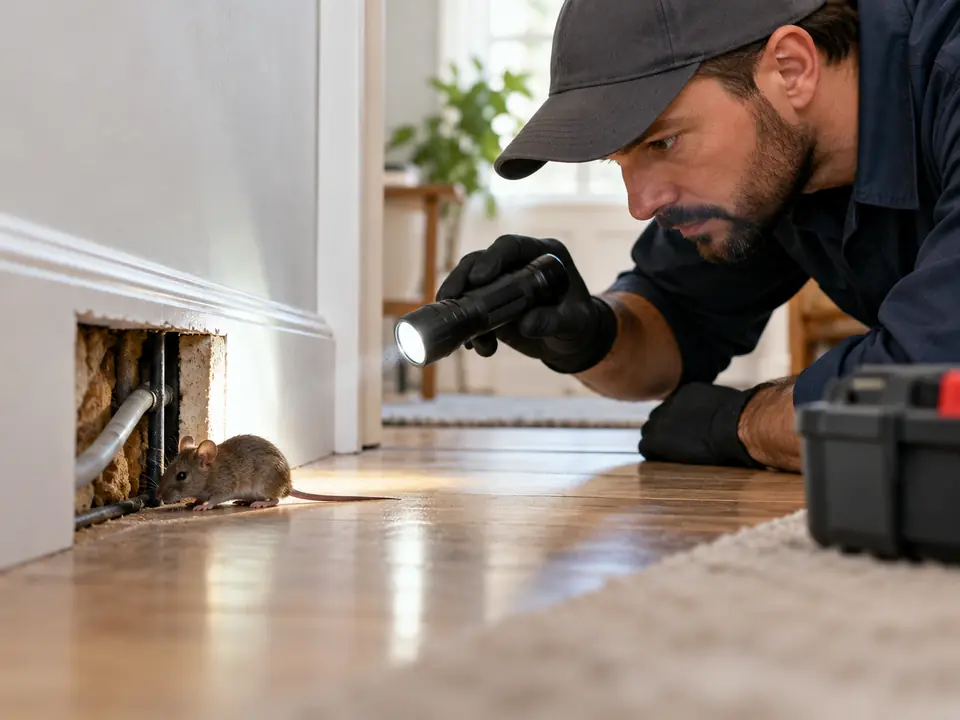
Illustrative scene of a pest-control professional inspecting a mouse entry point at a baseboard
Rodent Control · APOPKA, FL
⌖ Apopka, FloridaCall about this serviceReview the scope before approving work
The moment it’s worth calling

The moment it’s worth calling

01 / Symptom

Scratching or scurrying overhead at night

Roof rats are nocturnal — they forage after sunset and go quiet by dawn. We tell callers: if the sounds move across the ceiling in quick runs, that’s a rat-sized animal using the attic as a highway between nest and food. Mice make lighter, more localized scratching; rats sound heavier and travel further.
Do now: note which room the sounds are above and whether they happen after dark — both go into the inspection.

02 / Symptom

Droppings in the garage, attic, or along walls

We ID by droppings: rat droppings run 1/2 to 3/4 inch long with blunt ends; mouse droppings are rice-grain sized. Finding them along a garage wall or near the water heater usually means animals are traveling ground routes to food — while droppings in the attic point to the roofline.
Do now: don’t sweep or vacuum dry droppings — the CDC advises against it (dust can carry pathogens); note the locations instead.

03 / Symptom

Hollowed-out citrus or gnawed fruit on the ground

The roof rat’s local nickname is “citrus rat” for a reason — we see it every fall. Hollowed fruit still hanging on the tree — eaten from the inside — is textbook roof-rat sign, and fallen fruit on the ground is both evidence and the reason they stay.
Do now: pick up fallen fruit daily; check whether branches touch the roof, fence, or utility lines — those are the bridges.

04 / Symptom

Gnaw marks on wiring, vents, or food packaging

Rats gnaw constantly — their teeth never stop growing. We treat chewed wiring insulation in an attic as a fire hazard, not just damage; gnawed vent screens and eave gaps are usually the entry points being widened.
Do now: if you find chewed wiring, treat it as urgent — Emergency pest control in Apopka — and never seal a hole until you know whether animals are still inside.

What’s included

What rodent control covers — and what it doesn’t

Full inspection and identification — we map the route before anything is set or sealed: attic, roofline, eaves, vents, utility penetrations, garage edges. Rat vs. mouse matters: different trap sizes, different entry-point math.

Trapping the current population — snap traps in the right sizes, placed on the travel routes. We monitor them, never set-and-forget: a dead rat in a wall void is an odor problem for weeks.

Exclusion — sealing the structure — we close every entry point with steel, hardware cloth, and sealant — materials rats can’t gnaw through. This is the permanent fix; trapping without it just invites replacements through the same holes.

Attic sanitation guidance — droppings, urine, shredded insulation. Our inspection tells you what’s a cleanup job and what needs restoration: contaminated insulation loses R-value and holds odor.

Sanitation and habitat plan — the yard work that keeps them from coming back: fruit pickup, pet food in sealed containers, palm fronds trimmed back, seed pods off pindo and date palms.

Rodents in the walls get worse on a schedule — here’s the timeline:

What waiting costs

What waiting costs — the mechanisms, not the fear

A quiet attic in October

One pair becomes a population

A female roof rat can have 4–5 litters a year, 5–8 pups each — we explain this math on every rodent call the young start breeding at 3–4 months, and in Florida they breed year-round a crowded attic by spring — and every new generation learns the same entry routes

Every week of delay

Gnawing compounds

Each night of chewing widens entry gaps — we’ve watched nickel-sized holes become chewed-open vents in a season stripping more wire insulation and shredding more insulation for nesting a nickel-sized hole in November is a chewed-open vent by February — and the fire risk grows with every week

Droppings, urine, nesting debris

Contamination accumulates

The attic you could have cleaned in an afternoon becomes a restoration job — we see this escalation regularly shredded insulation also stops insulating the AC works harder all summer

Once a nest is established

They don’t leave on their own

Food and water nearby, nest established — the population grows until we change the equation the population grows until something changes the equation removing food alone rarely works if the entry points and nesting sites stay accessible

Three safety checks before anyone touches the attic

  • Don’t breathe the dust.

    The CDC advises against dry-sweeping or vacuuming rodent droppings — airborne dust can carry hantavirus and other pathogens. Wet the area, wear a mask and gloves, or leave the cleanup to our crew.

  • Check wiring before the attic.

    If rats have been up there, we assume chewed insulation on wires until verified. Don’t poke around bare wiring in the dark — kill the circuit if you must enter, or wait for our inspection.

  • Think twice about poison.

    Poisoned rats die inside walls and voids — the odor lasts weeks — and secondary poisoning threatens pets, owls, and hawks that eat the dying rat. We do trapping plus exclusion, the controlled approach; say no to broadcast bait you can’t monitor.

Apopka specifics

Why Apopka is roof-rat country

Citrus season is rat season

From September through March, backyard citrus ripens across Apopka — and UF/IFAS notes that hollowed fruit is the most common evidence of roof rats around homes. We tell people: a single productive orange tree feeds a colony all winter. The rats that ate quietly in your yard in November are the ones in your attic by January.

Palms are ladders

Roof rats are arboreal by nature — they nest in the skirts of old palm fronds and run along them like highways. Our rule of thumb: a rat can jump about 3 feet straight up and 4 feet horizontally, so a frond “almost touching” the gutter is still a bridge. Oaks, ficus, and fruit trees do the same job.

The cold-snap surge

Central Florida rodents live outdoors year-round — palms, dense landscaping, irrigation-fed yards. Then a cold snap drops nights into the 40s or 50s, and every rat within range heads for the nearest warm structure. We see calls spike roughly a week after the temperature drops. Peak indoor pressure runs October through February.

Older rooflines, more gaps

Mid-century Apopka homes have decades of eave gaps, loosened fascia, and utility penetrations that have widened over time. Newer builds near groves and preserves meet rodents at the property line before the landscaping matures. Either way, our inspection starts at the roofline.

How the job runs

How a rodent control visit runs, step by step

  1. Inspection and identification

    Attic, roofline, eaves, vents, soffits, utility penetrations, garage edges — we map every entry point and name the species from the evidence. Rat vs. mouse changes the trap sizes and the gap math (rats need ~1/2 inch, mice ~1/4 inch).

  2. Trapping the current population

    Snap traps sized for the species, placed on the mapped travel routes — attic runs, wall tops, garage paths. We check and clear traps on a schedule; nothing is left to die in a void.

  3. Exclusion

    Every entry point sealed with steel, hardware cloth, and sealant — materials rodents can’t gnaw through. We cover roof vents, close eave gaps, collar utility penetrations. This is the step that makes the fix permanent.

  4. Sanitation plan

    What to clean, what to replace, and the yard work — we spell it out: fallen fruit picked up, pet food sealed, palm fronds and seed pods trimmed back, branches cut 4+ feet from the roofline.

Before you call

Call now, or can it wait?

Call now

  • Gnawed or exposed wiring anywhere
  • Rodents in living spaces (not just the attic)
  • Droppings in food storage or the pantry
  • A dead-animal odor in walls
  • Anyone in the home with respiratory issues around heavy contamination

Schedule soon

  • Nighttime scratching confined to the attic
  • Droppings in the garage
  • Hollowed citrus and visible roofline gaps — the classic pre-infestation pattern

Have ready when you call

  • Where you hear the sounds and when (night vs. day matters)
  • Photos of droppings and gnaw marks
  • Whether branches or palms touch the roof
  • Whether you’ve seen fruit damage
  • If you can, note the fruit trees and palms in your yard and the neighbor’s — the route often starts next door

Crew scheduled? Here’s the day of:

During the visit

What to expect while the work is underway

  1. Inspection

    The inspection takes longer than the trapping

    Expect our inspection to take longer than the trapping — the roofline walk, attic entry, and eave-by-eave check are the whole point.

  2. Pets

    Keep pets secured

    Keep pets secured; mention aquariums and vegetable gardens upfront — we plan around them.

  3. Noise

    Exclusion means ladders and some hammering

    Exclusion work means our ladders at the eaves and some hammering at the roofline — plan around the noise if you work from home.

  4. Follow-up

    Traps get checked on a return schedule

    Traps get checked on a return schedule, not left indefinitely — we give you the check dates in writing. After sealing, you may hear reduced activity for a few nights as the remaining animals are trapped out — that’s the plan working, not a new problem.

Attic and roofline work puts us right where paper wasps like to build — in soffits, vents and along the edges of the roof. If a nest turns up while entry points are being sealed, wasp nest removal around rooflines and soffits clears it without driving the colony into the attic.

Helpful answers

What rodent control typically costs in Apopka

We price trapping and exclusion separately after the inspection — rodent jobs typically run from $200 depending on the entry points, and a one-time visit from $100. Here’s the breakdown.

ServiceTypical starting price
Rodent trapping & exclusionfrom $200
One-time visitfrom $100

Every problem's work and cost is different — the confirmed price comes only on the call or at inspection time. Starting prices below are typical, not fixed prices.

Rodent Control FAQs

How do I know if it's rats or mice in my attic?

Sound and size tell the story. Rats move with heavier, traveling runs across the ceiling; mice make lighter, localized scratching. Rat droppings are 1/2 to 3/4 inch long with blunt ends; mouse droppings are rice-grain sized. Rats need about a 1/2-inch gap to enter, mice about 1/4 inch. The species changes trap sizes and the exclusion math, so identification comes before any treatment.

Why do roof rats pick my house — and why the attic?

Roof rats are climbers by nature. Your palm trees, citrus, and oaks are the staircase; the roofline is the door. They prefer nesting above ground — attics, soffits, wall voids — and Florida gives them food and warmth year-round. A cold snap or a ripening citrus crop is usually what pushes a yard population into the structure. Remove the bridges and the food, and the attic loses its appeal.

Can't I just set traps myself and skip the professional?

Traps catch the current animals — they do nothing about the holes. We tell every DIY caller: without exclusion, new rats move in through the same openings, and the cycle repeats. Worse, a dead rat in a wall void means weeks of odor you can't reach. The permanent fix is trapping plus sealing every entry point with steel and hardware cloth. DIY trapping works as a stopgap; it isn't a solution.

Is poison a bad idea for rats in the attic?

For indoor use, yes — and here's why. A poisoned rat dies where you can't reach it: inside a wall void or ceiling, and the odor lingers for weeks while it decomposes. There's also secondary poisoning: pets, owls, and hawks that eat a dying rat can be poisoned too. Monitored snap trapping removes each animal accountably; exclusion keeps the next ones out. Poison has its place outdoors in locked bait stations — not in your attic.

Do I really need to seal the house, or will removing them be enough?

Sealing is the fix; removal is the cleanup. A female roof rat has 4–5 litters a year with 5–8 pups each, breeding year-round in Florida — we watch the population replace trapped animals fast. Every gap stays open for the next group unless it's closed with gnaw-proof materials. Companies that only trap and bait, visit after visit, are selling you a subscription to the same problem.

What should I do about droppings in the attic — clean it myself?

Don't dry-sweep or vacuum them — the CDC advises against it because airborne dust from droppings can carry pathogens like hantavirus. Wear a mask and gloves, wet the area before wiping, and bag everything. For heavy contamination — soaked insulation, widespread droppings — leave it to the crew; shredded, urine-soaked insulation often needs replacement, not just cleaning, since it stops insulating.

My neighbor has citrus trees and won't pick the fruit. Am I stuck?

Not entirely, but the route matters. A roof rat forages within a 200–300 foot radius — about a football field — so a neighbor's unpicked citrus can absolutely feed your attic population. You can't control their yard, but you can control your structure: seal your entry points, trim your branches back 4+ feet from the roofline, and remove your own attractants. Exclusion works even when the neighborhood stays attractive.

How fast can a small rat problem become a big one?

Faster than the scratching suggests. Young rats breed at 3–4 months old, litters run 5–8 pups, and Florida's year-round breeding means no winter die-off to reset the count. What sounds like "a rat" in October is often a family by February — and every generation learns the same entry routes your house already offers. The inspection is cheapest when the sounds are new.

Can I find rodent control near me in Apopka?

Start here: this page explains the work, the common causes, and the questions worth asking. Then call the number listed for rodent control and confirm coverage for your address.

Further reading

Sources and technical references

View supporting references and safety sources
  1. UF/IFAS Extension

    Roof-rat biology, breeding, and control in Florida; landscaping guidance on pruning limbs, palms, and fallen fruit.

  2. CDC

    Cleanup guidance for rodent droppings: no dry sweeping or vacuuming; wet-clean with protective equipment.

  3. UC IPM

    Roof-rat damage documentation: wiring gnawing, insulation shredding, and why exclusion is essential for long-term control.

Rodent control succeeds or fails on what happens after the traps, because rats treat the whole house as one connected system. In the kitchen they nest behind and beneath appliances, chewing supply lines and wiring as they go — a fridge with gnawed wiring behind it, a dishwasher with a chewed drain hose, and a washer with a punctured fill line are all rodent damage as much as appliance failure, and each repair holds better once the animals are gone. The warm insulation inside a range is another favorite nest site, which is why a burning smell from the oven sometimes traces back to nesting material rather than the element. Above the ceiling, exclusion is only as good as the roofline it attaches to: chewed soffit vents and lifted flashing need proper roof repair to seal rodent entry points, and when the roof itself is at the end of its life, homeowners often time the final exclusion work to a roof replacement that closes every gap at once.

Comparing rodent proposals? Exclusion-first vs. trap-only is the decision that matters — a proposal without sealing is a recurring bill. See what a complete scope looks like, and how the call-now vs. wait decision works across every trade.

How to compare home service estimates ↗ When to call a home professional ↗

Hear it tonight? Inspect before you seal.

Call with where the sounds are, when they happen, and what you’ve found. The visit maps every entry point first — then traps, seals, and hands you the prevention plan.

Apopka, FLRodent Control ☎ (407) 537-0972