APOPKA, FL · HOME REPAIR & RESTORATIONExplore Apopka service area
Home Services ApopkaCall (407) 598-8705 ↗
Home services · Apopka, FL

Lawn Care in Apopka, FL

Brown patches spreading by the week. A sprinkler zone that mists the sidewalk more than the grass. An HOA letter about the lawn — or a water bill that doubled with nothing to show for it. We read Apopka lawns for a living: chinch bugs in the heat, fungus in the cool months, sandy soil that drains before roots drink, watering rules that punish guessing. Tell us what you're seeing — we'll name it, then fix it: mowing and maintenance, new sod, or irrigation repair. Homeowners looking for lawn care near me in Apopka usually start with the symptoms: this page walks through the common causes and the questions worth asking before you call.

We connect you with licensed and insured lawn care contractors in Apopka, FL.

Daily · 9 AM–5 PM CST. Confirm available lawn-care appointments.

Hours above use the answering service’s listed MST/CST time zone, not Apopka Eastern Time. Confirm today’s local calling and appointment hours when you call.

Start with what you're seeing. We read the pattern the way you'd read a gauge — it usually names the problem.

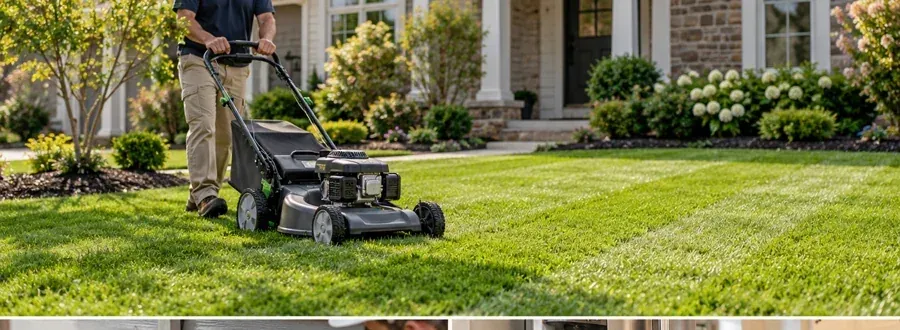
Freshly mowed St. Augustine lawn with crisp edging at an Apopka, FL home
Lawn Care & Outdoor Services · APOPKA, FL
⌖ Apopka, FloridaCall about this serviceReview the scope before approving work
Know the signs

What your lawn is telling you

01 / Symptom

Yellow patches spreading in the heat, starting near concrete

Chinch bugs — we diagnose these weekly in summer. They feed where it's hottest and driest, along driveways and curbs, sucking the runners until patches yellow, brown, then die. A new generation hatches every 4–6 weeks, so June's small patch is August's dead zone. We do the coffee-can test on every suspect call: bottomless can sunk 2 inches at the damage edge, fill with water, wait 5 minutes. Tiny black-and-white bugs float up? Chinch bugs, not drought.

02 / Symptom

Brown rings with green centers, showing up in fall or spring

Large patch fungus — ours wakes when nights drop below 80°F, November through May. It loves leaves wet 48 hours or more. The tell: circles of dead turf with healthy-looking grass in the middle, sometimes an orange ring at the edge. Tug a blade near the edge — slips out rotted at the base? Fungus, not insects. We tell every caller: stop watering in the evening; early morning only, and only when the lawn actually needs it.

03 / Symptom

Sprinklers running, but dry crescents or one soggy corner anyway

Dry spots that never green up no matter the schedule? That's a coverage problem, not a timer problem — we find misaligned heads, clogged nozzles, heads spaced too far apart. No timer setting fixes geometry. Meanwhile the dry spots thin out, weeds move in, and the water bill climbs for nothing. Watch one full zone run with us: if the spray doesn't overlap head-to-head, the zone needs repair, not more minutes.

04 / Symptom

A violation letter: overgrown, brown, or non-compliant lawn

Apopka enforces vegetation height — the city fined one golf-course property over $1.7 million with overgrown grass among the violations — and HOAs in subdivisions like Rock Springs Ridge, Errol Estate, and Whispering Oaks run their own lawn standards. But Florida's Florida-Friendly Landscaping law (F.S. §373.185) limits what an HOA can prohibit. We tell people: read the actual rule cited before you tear anything out; you may have more rights than the letter implies.

Find your fix

Which lawn service do you actually need?

Lawn Mowing & Maintenance — for lawns that are alive but need consistent care: correct mowing height by grass type (St. Augustine 3.5–4 inches, zoysia 1.5–2.5), the one-third rule (never cut more than a third of the blade at once), edging, and cleanup. This is the steady rhythm that keeps weeds out and HOAs quiet. If your grass is mostly green and you just can't keep up with it — start here.

Sod Installation — for lawns that are past saving: large dead areas, dirt patches, the wrong grass for the shade, or a yard you're starting from scratch. Central Florida's choice is mostly St. Augustine (best shade tolerance, thirstier) vs. zoysia (denser, more drought-tolerant, slower to establish). Timing matters — and during water restrictions, new sod may have to wait. If more than a third of the lawn is gone — start here.

Sprinkler Repair — for irrigation that doesn't irrigate: dry crescents, geysers from broken heads, zones that won't turn on, a timer you can't program, or a water bill that spiked. Under SJRWMD rules you get two watering days a week in summer and one in winter — a broken system wastes both of them. If the grass is dying in patterns that match your sprinkler zones — start here.

Picked your lane? A quick call sorts out the rest — including whether the problem is really the lawn at all.

Cost of waiting

What waiting does to a Florida lawn

Chinch bugs, left through the summer

Chinch bugs don't pause

Chinch bugs don't pause. With a new generation every 4–6 weeks in summer, the patch you notice in June has doubled by July and the grass is dead, not dormant, by August — dead St. Augustine doesn't green back up; it gets replaced.

Large patch, left for next fall

Large patch works the other direction

Once it takes hold, large patch returns every fall when conditions are right, in the same spots, wider each year. Prevention beats cure by a wide margin — fungicide timing in September beats rescue treatment in December.

Overwatering, left on autopilot

Overwatering compounds everything

Overwatering compounds everything. Too much water builds thatch, thatch shelters insects, and shallow roots make the lawn more drought-sensitive — the exact opposite of what the extra water was for. UF/IFAS is blunt about it: overwatering causes more disease and weaker turf than underwatering does.

A neglected lawn, left to thin

A scalped or neglected lawn invites weeds

A scalped or neglected lawn invites the one thing that makes every other problem worse: weeds. Thin turf can't compete; by the time the weeds are visible, the lawn has already lost the ground underneath them.

Three checks before the work starts

  • Know what's been put down.

    If the lawn was recently treated, keep kids and pets off until the label says safe — usually once it's dried, but the label's the rule, not the calendar. Tell our crew what's been applied and when.

  • Sprinkler wiring is low-voltage, not no-voltage.

    Timer boxes and valve wiring carry current — don't open controllers or dig around valve boxes powered. We kill power at the controller before touching wires.

  • Florida heat is the real hazard.

    Lawn work happens in it all summer. If you're doing any of this yourself: water, shade breaks, and morning hours. Heat exhaustion doesn't announce itself politely.

Apopka specifics

Apopka plays lawn care on hard mode

The water rules are real, and they've bitten before

In April 2024, Apopka declared a "state of water supply conservation" — residents were told to stop all outdoor watering, and the district asked nobody to lay new sod until restrictions lifted. Violators faced $50, then $100, then $500 fines. The everyday SJRWMD rules still apply: two watering days a week in daylight-saving months (odd addresses Wednesday/Saturday, even Thursday/Sunday), one day a week in winter, never between 10 a.m. and 4 p.m., never more than ¾ inch per zone. Two days is a ceiling, not a target.

The soil is sand, and sand doesn't negotiate

Apopka sits on sandy soil that drains fast — water runs through before roots drink deeply. That's why UF/IFAS says to water deeply but infrequently (½–¾ inch, only when the lawn shows stress: folded blades, blue-gray tint, footprints that stay). Daily light watering trains roots to live at the surface, where the next dry spell kills them.

The pests and diseases are on a Florida schedule

Chinch bugs own the summer; large patch owns November through May. Fall pre-emergent for winter weeds goes down when nights hit 55–60°F for several days running — usually late October to early November here. Miss the window and you're fighting weeds you can already see, which pre-emergent can't touch.

HOAs watch lawns closely — but the law watches back

Many Apopka subdivisions enforce appearance standards, and Florida's Florida-Friendly Landscaping statute (F.S. §373.185) says an HOA can't prohibit Florida-friendly choices. If your HOA demands a specific look, we help you know where their authority ends.

How it works

What a real lawn assessment covers

  1. Walk the whole property first

    We walk every zone before touching anything — grass type and condition, shade patterns, drainage, where the irrigation actually reaches. We read the lawn like a map, not mow it like a chore.

  2. Identify the grass and the problem

    St. Augustine and zoysia need different heights, different nitrogen, and get different pests. Our assessment names both: what you're growing and what's attacking it. Brown doesn't always mean thirsty — we check for bugs, fungus, and rotted roots from overwatering before we add a drop.

  3. Audit the irrigation

    Each zone runs while we watch: head-to-head coverage, broken or sunken heads, pressure issues, timer programming against your watering days. Most "brown lawn" calls we get end right here — the grass was fine; the water never arrived.

  4. Check soil and thatch

    Sandy soil, compacted areas, thatch over half an inch — these decide whether the fix is cultural (mowing, watering, aeration) or a restart (sod).

  5. Lay out the plan in order

    What happens first, what it depends on, and what you should expect to see and when. No single visit fixes a lawn; the plan should say that honestly.

Before you call

Call now, or can it wait? — and what to have ready

Call now

  • Brown patches spreading week to week (chinch bugs or fungus won't wait), an HOA violation letter with a deadline, sprinklers broken during a heat wave, or standing water from a stuck valve. Spreading damage is always urgent in Florida — the calendar is the enemy.

Can wait for a scheduled visit

  • Routine mowing and maintenance, planning a sod project for the right season, a timer you can't figure out, pre-emergent timing questions. These deserve a proper assessment, not a panic call.

Have ready when you call

  • Your grass type (St. Augustine or zoysia — a photo of the blades helps)
  • Which watering days your address gets
  • Photos of the problem areas
  • Any HOA letter or rule cited
  • What's been put on the lawn lately (fertilizer, weed killer, insecticide — and when)

Call made and visit scheduled. Here's what the day of the work looks like:

During the visit

What to expect while the work is underway

You don't need to hover, but stay reachable — we may need a decision on the spot (a head location, a gate, the timer password).

  1. Mowing

    Mowing visits

    We run a route rhythm: mow at the right height for your grass, edge the hard surfaces, trim what the mower can't reach, blow clippings off the driveway and walks — never into the street or storm drain. We alternate mowing direction so the grass doesn't develop a grain.

  2. Assessment

    Assessment or repair visits

    We start with the walk-through above. For irrigation: zones tested one by one, heads replaced or adjusted, timer reprogrammed to your watering days. You'll hear the zones cycle — that's normal, that's the sound of us finding the problem.

  3. Sod consult

    Sod consultations

    Sod jobs start with measuring, a grass-type discussion for your shade and sun, and timing: sod needs its 30-day establishment watering, so the schedule has to fit the water rules. If restrictions are active, we'll tell you honestly: not yet.

Helpful answers

What lawn care typically costs in Apopka

We price by the yard and the plan — a full lawn care program typically runs from $400/yr depending on the yard, and irrigation maintenance from $225/yr. Here's the breakdown.

ServiceTypical starting price
Full lawn care program (year)from $400/yr
Irrigation maintenance (year)from $225/yr

Every problem's work and cost is different — the confirmed price comes only on the call or at inspection time. Starting prices below are typical, not fixed prices.

Lawn Care FAQs — Apopka, FL

Brown patches are spreading across my St. Augustine — and my neighbor has them too. What is it?

In summer heat, spreading yellow-to-brown patches starting near driveways and sidewalks are usually chinch bugs — we see it weekly. They feed where it's hottest and driest, and a new generation hatches every 4–6 weeks. Confirm with the coffee-can test: sink a bottomless can 2 inches in, fill with water, wait 5 minutes. Floating black-and-white bugs mean insects, not drought — and watering harder just feeds the thatch they hide in.

What days can I legally water my lawn in Apopka?

Under SJRWMD rules: during daylight-saving months, odd-numbered addresses water Wednesday and Saturday, even-numbered Thursday and Sunday — two days max. In winter (Eastern Standard Time), it's one day a week: Saturday for odd, Sunday for even. Never between 10 a.m. and 4 p.m., never more than ¾ inch per zone. New sod and landscaping are exempt for the first 30 days. Two days is a ceiling, not a target — water only when the lawn shows stress.

St. Augustine or zoysia — which should I plant?

St. Augustine is Central Florida's default for a reason — we lay it most: best shade tolerance of the warm-season grasses, fast to establish from sod. Zoysia is denser, more drought-tolerant, and needs less nitrogen — but slower to establish and mowed lower (1.5–2.5 inches vs. 3.5–4 for St. Augustine). Shady yard: St. Augustine. Full sun, low water, and patience: zoysia. Never mix them — they need different insects, chemicals, and fertilizer programs.

My HOA sent a lawn violation letter. What are my rights?

Read the letter first — it must cite the specific rule. We tell every HOA-letter caller this: Florida HOAs can fine up to $100 per violation (max $1,000 aggregate) but must give 14 days' written notice and a hearing before a grievance committee (F.S. §720.305). And Florida's Florida-Friendly Landscaping law (F.S. §373.185) bars HOAs from prohibiting Florida-friendly landscaping choices. Fix what's genuinely neglected; push back on what the law protects.

Can I lay new sod right now?

Depends on the water rules in force. New sod needs daily watering for 30 days, then every-other-day for 30 more — exempt from restrictions for that first 30 days. But during severe restrictions, the district has asked residents not to install new sod at all (as in Apopka's April 2024 order). We'll tell you straight whether now's the time. Summer heat makes establishment harder; fall and spring are kinder. Ask about current restrictions before scheduling.

How often should my lawn be mowed in a Florida summer?

Often enough that you never remove more than one-third of the blade at once — in peak growing season we're usually out weekly. St. Augustine stays at 3.5–4 inches; zoysia at 1.5–2.5. We raise the height half an inch to an inch as heat builds; taller grass shades its own roots and crowds out weeds. Scalping — cutting it short to "get ahead" — weakens the turf and is the fastest way to invite weeds.

My sprinklers run, but I still have dry spots. More water?

No — and we say this on half our sprinkler calls: more water won't fix a coverage problem. Dry crescents and one soggy corner mean heads are misaligned, clogged, or spaced too far apart; the water isn't reaching the dry spots no matter how long the zone runs. Watch a full zone cycle: spray should overlap head-to-head. If it doesn't, the zone needs repair — new nozzles, raised heads, or re-spaced coverage — not more minutes on the timer.

Every fall I get brown rings with green centers. Same thing each year?

Yes — that's large patch fungus, and we watch it return to the same spots every fall once established. It activates when nights cool (November through May), especially where leaves stay wet 48+ hours. Prevention starts in September: avoid quick-release nitrogen in fall, water only early morning, and improve drainage in low spots. By the time the rings are obvious, you're treating, not preventing — which is why the fall routine matters more than the fall rescue.

What should I check before booking lawn care near me in Apopka?

Check that the team covers Apopka, handles your specific problem, and can confirm an appointment for your address. This page lists what lawn care involves and the number to call.

Further reading

Sources and technical references

View supporting references and safety sources
  1. UF/IFAS Extension

    Florida's lawn authority: St. Augustine and zoysia management guides, southern chinch bug identification and control, large patch (brown patch) disease management, and the "water only when the lawn shows stress" irrigation standard. (No credentials claimed — these are public university publications.)

  2. St. Johns River Water Management District (SJRWMD)

    the mandatory watering schedule: days, hours, and per-zone limits for Orange County.

  3. Florida Statutes

    §373.185 (Florida-Friendly Landscaping: HOAs can't prohibit it) and §720.305 (HOA fine limits, notice, and hearing rights).

  4. City of Apopka

    April 2024 water-conservation order and vegetation code enforcement, as reported by local news.

A lawn does not fail in isolation, and neither does the house behind it. After a major storm, the same wind that strips shingles buries turf in debris, and the order matters: stabilizing an actively leaking roof comes before any yard cleanup, because water inside the house outranks grass every time. Smaller roof failures show up in the lawn too — granules washing off shingles collect at downspout outlets and scorch the turf there, a clue that points back to a roof surface that needs repair rather than another round of fertilizer. Yard pest outbreaks follow the same outward pattern: fire ants boiling up across a freshly mowed lawn or rodents burrowing along the fence line can escalate into an urgent pest situation when they reach the house. To see which of these services run in your part of town, check the areas we serve page for current coverage.

And if you're still deciding how to hire: Florida rainy-season home checklist — summer storms change what your lawn, roof, and drainage need, all at once. When to call a home professional — the call-now vs. wait decision, generalized across every trade.

Read the related homeowner guide ↗

Call About Lawn Care in Apopka

Call about mowing, sod, irrigation or the specific lawn problem and confirm availability for that work.

Apopka, FLLawn Care & Outdoor Services ☎ (407) 598-8705