APOPKA, FL · HOME REPAIR & RESTORATIONExplore Apopka service area
Home Services ApopkaCall (407) 469-7577 ↗
Appliance Repair · Apopka, FL

Microwave Repair in Apopka, FL

The microwave hums, the light comes on, the plate turns — and the food comes out cold. Or the display is dead after a storm, the turntable has stopped, or the inside sparks when it runs. A microwave fails in small, specific ways, and each one points at a different part: the magnetron, the door switches, the control board, the turntable motor. We read those symptoms for a living, and we test before we name a part. Match your symptom below — we will tell you what is urgent, what can wait, and how we diagnose it before quoting anything. If you are looking for microwave repair near me in Apopka, the symptom is where the diagnosis starts, and this page explains what we check and what to ask about.

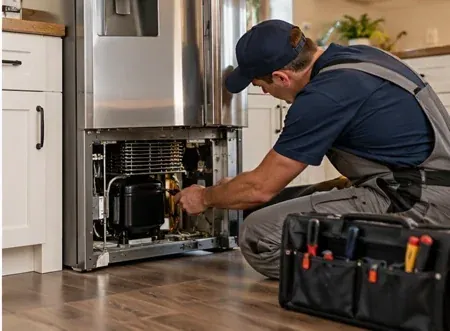
Technician diagnosing a microwave that stopped heating in an Apopka, FL kitchen
Microwave Repair · Apopka, FL
⌖ Apopka, FloridaCall about this serviceReview the scope before approving work
The moment it's worth calling

Which pattern matches your microwave?

01 / Symptom

Runs, lights up, and turns — but the food stays cold

The light, the fan and the turntable all work, yet a cup of water barely warms: that is the classic magnetron or high-voltage fault. The magnetron makes the heat; the diode and capacitor feed it the voltage it needs. When any of them fails, the microwave looks alive and heats nothing. Stop using it — running a cold microwave strains the parts that still work — and tell us whether the hum changed or went quiet, because that one detail steers the whole diagnosis.

02 / Symptom

Dead display, no power at all

Nothing on the display and no response to any button usually means power never reached the control board, or the board itself failed. First we check the easy end: the breaker, and any GFCI outlet on the same kitchen circuit — a tripped GFCI after a storm is a common Apopka call. If the outlet is live and the unit stays dark, the fault is inside: the line fuse, a door switch, or the control board. Do not open the case to look — the capacitor inside can hold a charge after unplugging.

03 / Symptom

Turntable stopped, or the microwave sparks inside

A tray that will not turn is usually the turntable motor, the coupler under the tray, or a roller ring off its track — the food still heats, but unevenly, with hot and cold spots in one plate. Sparking is different and urgent: a burned waveguide cover, chipped paint inside the cavity, or metal left on a plate. Stop the microwave immediately, unplug it, and do not run it again to see if it clears up — every spark pits the cavity wall deeper.

04 / Symptom

Buttons don't respond, or it runs with the door open

Buttons that need three presses, or a whole row that is dead, point at the touchpad membrane or the control board behind it. A microwave that keeps running with the door open is a failed door interlock switch — that is a safety fault, not a quirk: unplug the unit immediately and do not use it again. Note exactly which buttons fail and whether the fault came on after a storm, because control boards are the part Florida lightning kills most.

Understand the work

What microwave service covers — and what it doesn't

  • Diagnosis first. Power at the outlet, door-switch continuity, control response, and high-voltage circuit testing with a meter. The numbers come before any part gets ordered.
  • Magnetron, diode, and capacitor replacement. The high-voltage set that makes the heat. This work stays with the technician: the capacitor can hold a charge after unplugging, so the case is never opened on a guess.
  • Door switches, latches, and interlocks. Testing and replacement of the switches that must all agree before the microwave is allowed to run — including the safety interlock that stops it when the door opens.
  • Turntable, light, fan, and touchpad. Turntable motor and coupler, roller ring, interior light, cooling fan, and touchpad or control-board diagnosis for dead or unresponsive buttons.
  • Countertop, over-the-range, and built-in models. Over-the-range units get their vent fan and filter checked too, since a clogged vent is part of the failure story in a working kitchen.
  • Repair-or-replace math, in plain words. Microwaves typically last about seven years. On an older countertop model, a magnetron repair can cost close to a new unit, and we will say so. Our appliance repair hub covers the same decision across the rest of the kitchen, and our refrigerator repair page covers the other appliance that fails the same way after a storm.

What is not in the scope: cabinetry or ductwork changes beyond the unit's own vent connection, and installing a brand-new replacement unit — if the verdict is replacement, we tell you the size and type to buy rather than fitting it as a repair.

That's the scope. The question underneath it is timing — and with a microwave, timing is measured in parts, not just patience.

Cost of waiting

What waiting does to a microwave — the mechanisms, not the fear

A small fault becomes the expensive part

A small fault becomes the expensive part A failing diode or capacitor forces the magnetron to work against a bad supply, and magnetrons that die from chronic strain do not get repaired, they get replaced — at a price close to a new countertop unit. A worn door switch left alone can take the control board with it. A sparking waveguide cover left running pits the cavity until the cavity itself is the problem. Each of these starts as the cheap part.

The safety margin shrinks

The safety margin shrinks A microwave that heats unevenly is not just annoying — cold spots in reheated food are a food-safety problem, since microwaves are expected to bring food to temperature throughout. And a door interlock that is starting to fail is a safety device wearing out in plain sight. Neither fault improves with time, and both are cheaper the week they appear than the month after.

None of this is panic. It just means a microwave that stopped heating, or started sparking, is a call-now decision — we tell every caller that.

Three checks before the work starts

  • Unplug it — and leave the case closed.

    The high-voltage capacitor can hold a charge after unplugging, so the back panel stays on until a technician with the right tools opens it. Unplugging is the homeowner's job; discharging the capacitor is ours.

  • If it sparks, smokes, or smells of burning, stop.

    Switch it off, unplug it from a dry spot, and do not run it again to test it. Note where the sparks appear — on the wall of the cavity, near the waveguide cover, or on the food itself — and tell us on the call.

  • If it runs with the door open, unplug it immediately.

    A microwave that keeps running with the door open has a failed interlock, and it must not be used again. Keep children away from it until it is unplugged and assessed.

Apopka specifics

Why Apopka is hard on microwaves

Storms and surges

Florida leads the nation in lightning, and a microwave control board is exactly what a surge kills — display dead, buttons unresponsive, right after a summer storm rolls across Lake Apopka. We replace more control boards after storms than any other microwave part. A surge protector on the kitchen circuit helps, but it is not a sure thing: if the unit died the night the lights flickered, tell us, because the board is where our diagnosis starts.

Humidity and the second microwave

Plenty of Apopka homes keep a second microwave in the garage, the lanai, or an outdoor kitchen near Wekiwa Springs — and Florida humidity plus summer garage heat corrode contacts, swell touchpad membranes, and age a control board years faster than the one in the kitchen. If the garage unit's buttons are failing while the kitchen unit is fine, the problem is the room, not the brand, and we will tell you that before selling you a repair.

Over-the-range units in Florida kitchens

In homes from Rock Springs Ridge to Errol Estates, the over-the-range microwave is also the range hood — pulling steam and grease-laden air through its vent filter every time a pot simmers. A clogged filter makes the fan work harder, traps heat around the control board, and shortens the unit's life. We check the vent fan and filter on every over-the-range visit, because a microwave that keeps failing in a working kitchen is often a ventilation problem wearing an appliance disguise.

How the job runs

What happens during a microwave service visit

  1. Verify the symptom with instruments

    We confirm what you saw: power at the outlet, door-switch continuity, control response, and high-voltage readings where the symptom points. A magnetron pulling no current with a good supply is a very different answer than a dead control board — our meter decides, not guesses.

  2. Isolate the system

    Power, control, door, or high-voltage — we narrow to one system before naming any part. That is what separates our diagnosis from parts-swapping: we identify the failed part, we don't assume it.

  3. Scope in writing

    Then we lay it out: the failed part, whether it is on our truck or ordered, and what changes the scope — a magnetron on an older countertop unit changes the conversation to the repair-or-replace math. You approve before anything comes apart.

  4. Repair and verify

    Part replaced, cavity and waveguide cover inspected, door interlocks checked — then we run the microwave and verify with a cup of water: even heating, turntable turning, light and fan working, and the unit stopping the instant the door opens.

Before you call

Call now, or can it wait? — and what to have ready

Call now

  • the microwave runs with the door open
  • sparking, smoke, or a burning smell inside the cavity
  • completely dead and tripping the breaker when plugged in

Can wait for a scheduled visit

  • turntable stopped but the food still heats
  • interior light out, everything else normal
  • buttons need a second press now and then
  • fan noisier than usual with steady heating

What to have ready

  1. The machine. Brand, model number (on the label inside the door or on the back), type — countertop, over-the-range, or built-in — and approximate age. Age feeds the repair-or-replace decision.
  2. The symptom. What it does, what it does not do, when it started, and whether it followed a storm or a power cut. “Heats nothing since last night’s storm, display fine” is a diagnosis head start.
  3. The sound. If it clicks, buzzes, or hums oddly — a short phone recording. Technicians genuinely use these.

Repair or replace, in one line: under five years old, repair usually wins; past seven years with a magnetron fault, a new countertop unit usually wins; built-in and over-the-range models sit in between, because fitting the replacement costs more. We give you both numbers on the call.

Call made. Here's what the visit itself looks like, so there are no surprises.

During the visit

What to expect while the repair is underway

  1. Diagnosis first, then repair

    We work at the counter or pull an over-the-range unit down with two people — clear the counter below it and move anything stacked on top. Most of the first visit is diagnosis: outlet and power checks, door-switch testing, control response, and high-voltage readings. Part on the truck? We fix it the same visit, subject to availability. Control boards and magnetrons we sometimes order — ask us upfront which one you are in for. Keep children out of the kitchen while the case is open. Before we leave: ask what we replaced, what the heat test showed, and what to watch for in the next week. We put it in writing — parts and labor itemized.

Homeowners often ask how these jobs connect, because one problem in an Apopka home rarely travels alone. A range fault in the middle of a kitchen project is worth sorting through oven repair when the temperature drifts before new counters go in.

Helpful answers

What microwave repair typically costs in Apopka

Most microwave repairs we handle start from $100, based on the published national average from Angi. The confirmed price comes only on the call or at inspection time.

ServiceTypical starting price
Microwave repair (typical)from $100

Every problem's work and cost is different — The confirmed price comes only on the call or at inspection time. Starting prices below are typical, not fixed prices.

Microwave Repair FAQs

Why does my microwave run but not heat the food?

The part that makes the heat — the magnetron — or the high-voltage circuit feeding it has usually failed, even though the light, fan and turntable still work. A weak door switch or a failed diode or capacitor can cause the same symptom, so we test the circuit rather than guess at parts. Stop using the unit and call us; running a microwave that is not heating can strain the parts that are still working.

My microwave is completely dead. Is it the outlet or the microwave?

Start with the outlet: check the breaker and any GFCI outlet on the same kitchen circuit, and try a lamp in the same socket to confirm power is reaching it. If the outlet is live and the display stays dark, the fault is inside the unit — usually the fuse, a door switch, or the control board. Do not open the case yourself; the capacitor inside can hold a charge after unplugging.

Is it safe to use a microwave that sparks inside?

No — stop using it and unplug it. Sparking usually comes from a burned waveguide cover, chipped paint inside the cavity, or a piece of metal left on a plate, and every spark pits the cavity wall deeper. Do not run the microwave again to see if it clears up. Tell us where the sparks appear and whether there is a burning smell, and we will check the cover, the cavity and the magnetron before switching it on.

The turntable stopped turning. Does that need a repair?

Usually, yes, and it is often a small job: a worn turntable motor, a cracked coupler underneath the tray, or a roller ring that has come off its track. The microwave may still heat, but food cooks unevenly when the tray does not turn, with hot and cold spots in the same plate. Check first that the tray is seated properly and nothing is jammed underneath it, then call us if it still will not turn.

My microwave is eight years old and the magnetron failed. Repair or replace?

At eight years, replacement is usually the better call for a countertop model. Microwaves typically last about seven years, and a magnetron is one of the most expensive parts, so the repair can cost close to a new unit. The math changes for a built-in or over-the-range model, where fitting a new unit costs more. We will give you both numbers on the call so you can decide with real figures, not a guess.

How long does a microwave repair visit take?

Most visits take under an hour once we are at the bench: diagnosis first, then the repair if the part is on the truck. Door switches, fuses and turntable motors usually are. Control boards and magnetrons sometimes need ordering, in which case we confirm the part and a return time before we leave. Appointment timing depends on availability, so confirm your slot when you call.

What should I have ready when I call about a microwave repair?

The brand, the model number from the label inside the door or on the back, whether it is a countertop, over-the-range or built-in model, and roughly how old it is. Then the symptom in plain words: what it does, what it does not do, when it started, and whether it followed a storm or a power cut. A short phone recording helps if it clicks, buzzes or hums oddly.

Is there microwave repair near me in Apopka?

Yes — we serve homes across Apopka, and the number on this page connects you with the team that handles microwave repair for your address. Confirm availability and timing when you call, and have the brand and model ready so we can check parts before the visit.

Further reading

Sources and technical references

View supporting references and safety sources
  1. Angi — How Much Does Microwave Repair Cost? [2026 Data]

    Published national figures for microwave repair and the typical seven-year service life used for the repair-or-replace guidance on this page.

  2. U.S. Department of Agriculture, Food Safety and Inspection Service — Microwave Ovens and Food Safety

    Even-heating guidance and why cold spots in microwaved food matter for food safety.

  3. U.S. Food and Drug Administration — Microwave oven safety

    Door-interlock and leakage-safety expectations for microwave ovens, and why a unit that runs with the door open must not be used.

  4. Manufacturer use-and-care manuals

    Model-specific diagnostics, the warning against running a microwave empty, and operating guidance for countertop, over-the-range, and built-in models.

A dead microwave is sometimes a symptom rather than the disease. Rodents nesting in warm appliance cavities chew the same wiring harnesses here that they chew everywhere else, and droppings or shredded insulation behind the unit mean the repair should be paired with getting the rodents out of the walls before new parts go in. If insects are swarming out of the vents or the unit is one of several kitchen appliances suddenly crawling with roaches, treat it as a pest emergency in the kitchen rather than a simple electronics fault. While the microwave is off the wall, it is also the natural moment to check the built-in machine beside it — a dishwasher that is leaving grit on glasses often traces back to the same hard-water scale that clouds microwave sensors and door switches.

Before scheduling the repair: Review the estimate details and consider whether the problem needs professional attention now.

When to call a home professional ↗ How to compare home service estimates ↗

When to call a home professional — the call-now vs. wait decision framework, generalized across every trade.

How to compare home service estimates — what a real appliance quote contains, and the red flags that matter on high-voltage jobs.

Need Microwave Repair in Apopka, FL?

Before authorizing work, ask about the likely part, whether it is on the truck or ordered, and whether repair is practical for the age of your unit. Call the service number to confirm service coverage and appointment availability.

Apopka, FLMicrowave Repair ☎ (407) 469-7577