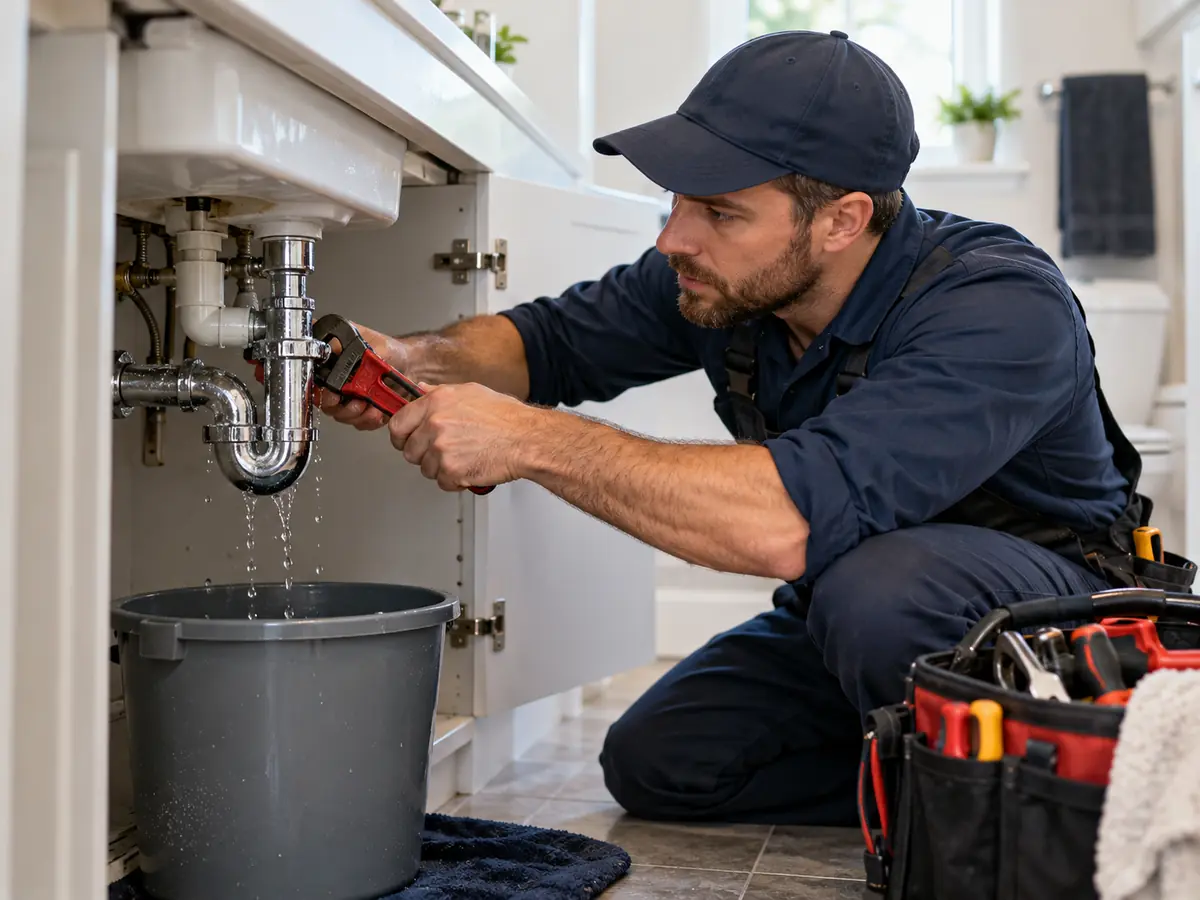
Leaking pipes or fixtures
Tell us which fixture or room is leaking, whether water is still running, and whether a shutoff is close and safe to reach. Our rule of thumb: a drip you can see is usually a fitting we can reach; a leak you can only hear or see on the bill is a supply leak hiding somewhere — different repair, different clock.
Slow or blocked drains
One slow sink is almost always local — the trap or its branch line, cleared at the fixture. When several fixtures back up together, stop plunging individual drains and call us about the shared line instead. Plunging three fixtures separately never fixed a main.
Sewer backup symptoms
Gurgling, wastewater coming back through a low fixture, or a backup that keeps returning — we see all three every week. The first thing we tell callers: stop adding wastewater. Do not run the washer, do not flush, do not run the dishwasher. Every gallon you add is a gallon coming back up somewhere.
No hot water
Tell us whether every hot tap is affected, how long the water stays warm, and whether the heater is tank or tankless, electric or gas. That one sentence tells us where to start — one cold tap is a fixture or mixing valve, every tap cold is the heater, and we do not guess which until we hear it.
Hidden leaks or higher bills
A bill that jumped for no reason, damp finishes, or the sound of running water — we investigate all three. But none of them proves a slab leak on its own: we have seen all three turn out to be a running toilet or a bad irrigation valve. We locate the real source with proper testing before anyone talks repair.
Low or changing pressure
Tell us whether the change hits one outlet or the whole house, hot or cold, and whether it followed utility work or a visible leak. One outlet with low pressure is usually a clogged aerator or a failing fixture shutoff — a five-minute check, not a repipe conversation.
A dripping faucet is usually a worn cartridge or seat — not a reason to replace the whole faucet. We repair kitchen and bathroom faucets, cartridges, sprayer hoses, and leaking sink connections, and we tell you straight when the fixture itself is done.
Grease, sludge, and scale coating the pipe walls — a cable punches a hole through it, jetting scrubs the walls clean. We tell you on the call whether your line is a jetting candidate or a snaking job, because jetting a broken pipe is money wasted.
A tankless unit that goes cold mid-shower is usually a flow or scale problem, not a dead heater. We diagnose tankless no-heat, error codes, and ignition faults — and we tell you when descaling solves it versus when the unit is finished.
A leak under the house shows up as damp soil, a musty smell, or a water bill that climbs for no reason. We find the failed section, repair or reroute it, and tell you what the moisture did to the wood it sat on.
Galvanized pipe chokes down from the inside — we have cut open 40-year-old sections with a pencil-sized opening left. Repeated leaks, rusty water, or flow that keeps dropping are the classic trio. We assess the whole system before recommending a replacement path, because patching one galvanized leak just moves the next one down the line.
A sink, shower, or tub that drains slowly, or a blockage that comes back after plunging — we run a drain snake when the cable and access point match the pipe. When the same drain clogs twice, we stop snaking and start asking why: grease, roots, or a damaged section decides the next move.
Unexplained water use, wet ceilings, tenant complaints, leaks that keep coming back — in a commercial building the source is rarely where the stain is. We track the actual source with testing, not guesswork, and we work around your operating hours and occupied spaces.
Wet ground near the meter, a sudden pressure drop, or a supply leak between the meter and the house — we locate the break first. Digging up a yard on a guess is the most expensive way to find a leak. We confirm the spot, then we dig.
A humming disposal that will not spin is usually jammed, not dead — do not keep flipping the switch. We clear jams, fix under-sink connection leaks, and replace units that are genuinely finished. Under ten years old, it is usually worth the repair call.