APOPKA, FL · HOME REPAIR & RESTORATIONExplore Apopka service area
Home Services ApopkaCall (407) 537-0972 ↗
Pest Control · Apopka, FL

Termite Treatment in Apopka, FL

A cloud of wings at the porch light on a warm May evening. Pencil-thin mud tubes climbing the foundation. Sawdust-like pellets under a baseboard. In Central Florida, these are the three signatures of the one pest that eats your house — and each one points to a different species, a different treatment, and a different clock. We read the signs, do the job, and tell you what to ask before anyone treats a thing. For termite treatment near me in Apopka, the right next step depends on the symptoms — this page explains what to check and what to ask about.

We connect you with licensed and insured pest control contractors in Apopka, FL.

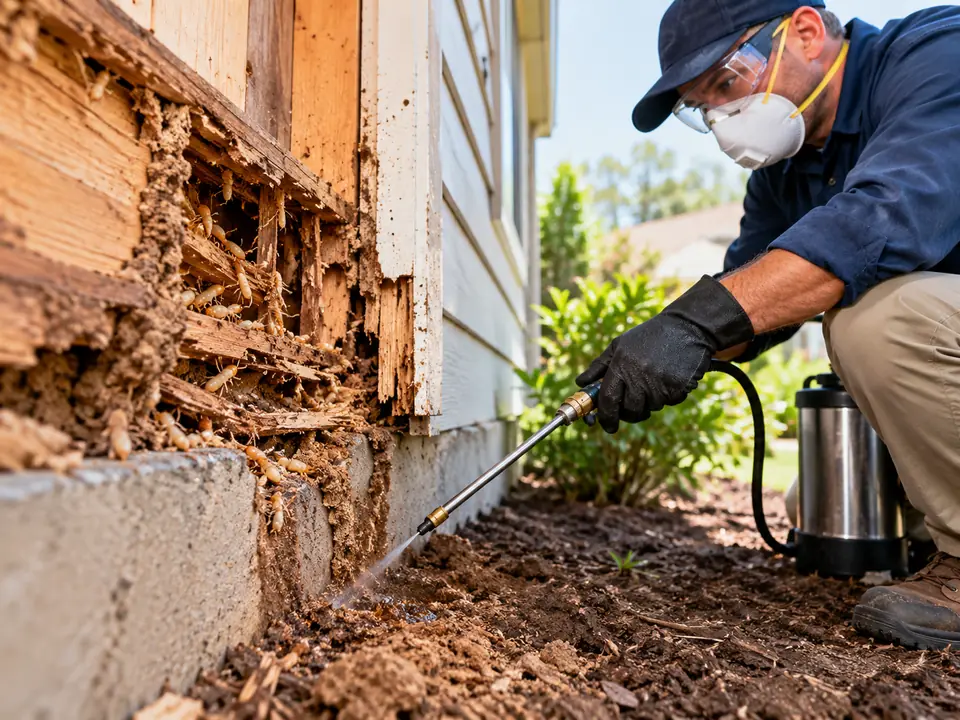
Illustrative scene of a termite-treatment specialist addressing damaged wood beside a home foundation
Termite Treatment · APOPKA, FL
⌖ Apopka, FloridaCall about this serviceReview the scope before approving work
Know the signs

The three signatures — and what each one means

01 / Symptom

A swarm of winged insects, especially at dusk after rain

Native subterranean termites swarm in Florida from February through June, often right after afternoon showers. Formosan termites swarm later — April through June — at dusk or after sunset, drawn to lights in clouds that can number in the tens of thousands.
First move: don’t spray — our rule. Capture one or two in a zip-lock bag for identification — killing the swarmers tells you nothing about the colony, and misidentification sends treatment the wrong direction.

02 / Symptom

Mud tubes on the foundation or interior walls

Pencil-thin tunnels of packed mud, about a quarter-inch wide, running from soil to wood. Subterranean termites can’t survive in open air, so they build these highways to travel hidden. Formosan tubes run wider — up to half an inch.
First move: don’t break them open and walk away — we tell every caller. Note where they start and end, and whether termites are active inside — that map is what the inspection follows.

03 / Symptom

Pellet piles or hollow wood, no mud in sight

We see these weekly: tiny six-sided pellets the color of wood, We see these weekly: piled under baseboards or windowsills, mean drywood termites — a different animal that lives entirely inside the wood, no soil contact, no mud tubes. Tap suspect wood: a hollow, papery sound with a thin surface shell is the classic giveaway.
First move: save the pellets in an envelope and note the room. Frass location is the inspection’s starting point.

Understand the work

What termite treatment covers — and where the boundaries are

Species identification first — our non-negotiable. Subterranean, Formosan, Asian subterranean, and drywood termites each demand a different treatment — and the treatments don’t cross over. UF/IFAS is explicit: identify the species before choosing a method. A specimen in a bag beats a guess from a doorway.

Subterranean treatment: bait systems — we ring the foundation with in-ground stations; foraging workers carry the bait’s growth-inhibiting active ingredient back and share it through the colony. Baits eliminate the colony that feeds on them — but they require monitoring visits on a schedule, and the system only works as long as it’s maintained.

Subterranean treatment: liquid barriers — we create a continuous treated zone in the soil around and under the foundation. Non-repellent termiticides ride home on workers’ bodies and spread through the colony by grooming; repellent types turn termites away. Liquids exclude colonies from the treated area but don’t eliminate the colony itself.

Drywood treatment: fumigation — drywood colonies live entirely inside the wood, so soil treatments can’t reach them. We treat established drywood infestations by tenting the structure — the whole building is sealed and fumigated, then ventilated and cleared before re-entry.

WDO inspections (“termite letters”) — the formal Wood-Destroying Organism inspection Florida lenders require in real-estate transactions: a state-prescribed report, performed only by a WDO identification card holder, documenting visible evidence, prior treatments, and inaccessibl — we perform these to the state form.e areas.

Bonds and warranties — ongoing protection agreements with scheduled inspections. We write ours to the Florida rules: the contract names the exact species covered — including whether Formosan termites are included — and states whether it covers retreatment only or damage repair too.

That’s the toolkit. Now the part that decides urgency: what the colony does while you deliberate.

Cost of waiting

What the colony does while you wait

Every season the colony stays active

The foraging territory expands

Workers forage and feed year-round in Florida’s climate — we see the damage in every season a mature Formosan colony can hold millions of individuals, with a queen laying roughly 2,000 eggs a day, foraging across several thousand square feet the damaged wood inside your walls keeps growing

A year on a Formosan infestation

The species matters to the clock

Formosan and Asian subterranean termites forage far more aggressively — we warn every caller about this a Formosan colony can compromise structural wood far faster than a native one waiting a year on a Formosan infestation is not the same decision as waiting a year on a native one

Years with no visible change

Drywood colonies run a quieter clock

Drywood colonies live entirely inside the wood — nothing visible changes while they expand, which is why we inspect on schedule nothing about the house changes visibly while they expand by the time frass piles appear or a surface gives under a tap, the colony has usually been established for years

Three rules before any treatment

  • Don’t spray the swarm.

    We mean it: a can of hardware-store spray kills the winged insects you can see and disperses the rest — which destroys the evidence needed for species identification and can push termites deeper into the structure. Capture, don’t kill.

  • Declare the household.

    Kids, pets, aquariums, vegetable gardens, and anyone with respiratory sensitivities must be part of the plan before treatment starts. We apply termiticides according to their labels; our plan states what’s used where and when each area is safe to re-enter.

  • Fumigation means fully out.

    If drywood treatment calls for tenting, the structure stays sealed for the full period — no quick trips back inside for the phone charger. We bag or remove food, medicines, and plants per the fumigant label, and re-entry happens only after the clearance reading.

Apopka specifics

Why Central Florida is termite country — and what the law requires

Florida’s warmth and moisture keep termites feeding twelve months a year — that’s our reality. Apopka sits in the overlap zone: native subterranean termites everywhere, Formosan colonies established across the state’s urban centers, and Asian subterranean termites — once a South Florida problem — now documented as far north as Orlando and Melbourne. Your home isn’t facing one termite; it’s facing a roster.

Contracts must name the species

Chapter 482, Florida Statutes — the pest-control law — requires a termite contract to state the common name of the organism being treated — and specifically whether Formosan termites are covered. We tell every customer: if the contract doesn’t say it, it doesn’t cover it. Read before signing.

WDO inspections are regulated

The “termite letter” your lender wants can only be performed by a WDO identification card holder or certified operator, on a state-prescribed report form. We list inaccessible areas — an attic we couldn’t enter gets noted, not skipped silently.

New construction gets pretreated

The Florida Building Code requires termite protection before the slab is poured — soil treatment or a bait system with a maintenance contract on file.

The Apopka ground truth

Mulch piled against siding, irrigation soaking the foundation line, and storm-season moisture all give subterranean termites exactly the damp, hidden wood-to-soil contact they want. That’s why our inspection starts outside, at grade.

How the job runs

What a termite job looks like, start to finish

  1. Evidence and identification

    You report what you saw and where; we inspect the foundation line, crawl space or slab edge, attic, and moisture-prone wood — and identify the species from specimens, tubes, or frass. Everything downstream depends on this step being right.

  2. The plan in writing

    Treatment method, target species, preparation you need to do, follow-up and monitoring schedule, and the contract terms Chapter 482 requires: species named, Formosan coverage stated, retreatment-vs-repair spelled out. We don’t start work until you approve the scope.

  3. Treatment

    We install bait stations around the perimeter, or trench and rod a liquid barrier into the soil — sometimes drilling through patios or garage slabs to reach soil beneath. Drywood jobs move to tenting and fumigation instead, on a separate schedule with its own preparation list.

  4. Monitoring and follow-up

    We inspect bait systems on schedule — the stations are the early-warning system. Liquid barriers get checked at the intervals the contract states. The job isn’t over at application; it’s over when monitoring shows no activity across consecutive checks.

Before you call

Call now, or can it wait? — and what to have ready

Call now

  • Active swarmers inside the house
  • Mud tubes on interior walls
  • Wood that gives under a tap
  • A WDO deadline on a real-estate closing

Schedule soon — or plan a visit

Schedule soon:

  • Old tubes with no visible activity
  • Frass in one spot you’re watching
  • A bond renewal coming due
  • A home you’re considering buying in an area with known Formosan pressure

Can wait for a planned visit:

  • General prevention questions
  • A neighbor’s swarm that wasn’t at your house — a scheduled inspection beats an anxious one

Have ready when you call

  • The evidence: captured specimen in a bag, or photos of tubes, pellets, and damage with something for scale
  • The timeline: when you first noticed it, whether it’s growing, and whether you’ve disturbed the area
  • The context: age of the home, any prior termite treatment or bond, and — if buying or selling — the lender’s WDO deadline
  • What species is this and how do you know?
  • What method fits this evidence, and why not the others?
  • What does the contract cover — retreatment only, or repair too?

Call made, plan signed. Here’s what the days of the work actually feel like.

During the work

What to expect while treatment is underway

  1. Bait day

    Bait installation day is the quietest option

    Small stations go in around the foundation perimeter every 10 to 15 feet — a day of digging and placing, no trenching, no drilling, and you stay in the house. The noise level is a shovel, not a machine.

  2. Liquid day

    Liquid barrier day is louder and more disruptive

    Expect trenching along the foundation, drilling through concrete patios, walkways, or garage slabs to inject termiticide beneath, and a crew working the full perimeter. Plan on the yard being a work zone for the day; plantings near the foundation may be disturbed.

  3. Fumigation week

    Fumigation week is the biggest production

    The structure gets tented — sealed under tarps — and you, the pets, and the plants move out for the full period stated on the label. Food and medicines are bagged or removed. Re-entry happens only after ventilation and a clearance reading, not when the tent comes down early.

  4. Throughout

    The technician should show and explain

    Through all of it: the technician should show you what was found, explain each step as it happens, and leave the written plan — monitoring schedule included — before driving off.

While we are outside checking foundation and siding lines, homeowners often point out a grey, papery nest hanging from the eaves above us. That is a different job from termite work, handled through removing a wasp nest from the eaves, and it is best dealt with before the colony peaks in late summer.

Helpful answers

What termite treatment typically costs in Apopka

We price by species and method after the inspection — termite treatment typically runs from $500 depending on species and method, and a WDO inspection (termite letter) from $100. Here’s the breakdown.

ServiceTypical starting price
Termite treatmentfrom $500
WDO inspection (termite letter)from $100

Every problem's work and cost is different — the confirmed price comes only on the call or at inspection time. Starting prices below are typical, not fixed prices.

Termite Treatment FAQs — Apopka, FL

I found a pile of wings on the windowsill after a rainstorm — termites or flying ants?

Check three features: termites have straight, beaded antennae, four wings of equal length, and a thick waist with no pinch. Flying ants have elbowed antennae, uneven wing pairs, and a narrow wasp waist. In Central Florida, subterranean termites swarm February through June, often right after rain. Save a specimen in a zip-lock bag — identification decides the entire treatment plan.

How do I know if I have subterranean or drywood termites — and why does it matter?

Mud tubes from soil to wood mean subterranean; six-sided pellet piles under baseboards with no mud mean drywood. It matters because the treatments are mutually exclusive: soil barriers and bait systems can't reach a drywood colony living entirely inside the wood, and fumigation is overkill for a subterranean colony. UF/IFAS guidance is explicit — confirm the species before choosing a method.

Bait stations or a liquid barrier — which fits my situation?

Baits work by elimination: foraging workers carry the growth-inhibiting active ingredient back and the colony collapses — but the stations need our monitoring on a schedule, indefinitely. Liquids create a treated zone that kills or repels termites crossing it, without eliminating the colony. Active interior activity often pushes toward liquid or a combination; prevention-focused plans often favor baits. Ask what each option's follow-up requires.

What's a WDO "termite letter," and when do I actually need one?

A Wood-Destroying Organism inspection report is the formal document Florida lenders usually require in a real-estate transaction. It must be done on a state-prescribed form by a WDO identification card holder, and it covers termites plus wood-boring beetles and decay fungi — not just termites. If you're buying or selling and the lender or contract requires one, ask the requesting party exactly which report form they accept before the inspector arrives.

My contract doesn't mention Formosan termites — am I covered?

In Florida, no — and this is the clause that matters most. Chapter 482 requires a termite contract to name the common name of the organism being treated and to state specifically whether Formosan termites are covered. If the contract doesn't say Formosan is included, assume it isn't. Also check whether the agreement covers retreatment only or damage repair too — those are different promises with different exclusions.

What actually happens during fumigation tenting?

We seal the structure under tarps and introduce a fumigant to reach drywood colonies living inside the wood. You, your pets, and your plants move out for the full period on the label — no quick trips back inside. Food and medicines are double-bagged or removed. Afterward the tent comes off, the structure is ventilated, and re-entry happens only after a clearance reading confirms the fumigant has dissipated.

How do I know the treatment actually worked?

For baits, the monitoring schedule is the answer: stations are checked on the contract's intervals, and the job is done when consecutive checks show no activity. For liquids, follow-up inspections look for new tubes or live termites at the treated perimeter. Don't judge by the absence of swarmers alone — swarming is seasonal, and a quiet spring doesn't mean a dead colony. Get the monitoring schedule in writing.

How do I find termite treatment near me in Apopka?

Look for a team that serves Apopka specifically, explains the work in plain language, and confirms availability for your address before booking. The number on this page connects you with our termite treatment team.

Further reading

Sources and technical references

View supporting references and safety sources
  1. UF/IFAS Extension

    Florida termite species identification, swarm timing, and the identify-before-treating rule; Formosan and Asian termite distribution research.

  2. Florida Statutes Chapter 482

    Pest-control licensing, WDO inspection requirements, and termite contract provisions including the Formosan-coverage rule.

  3. Florida Building Code

    Termite pretreatment requirements for new construction (soil treatment or maintained bait system before slab pour).

  4. U.S. EPA

    Termiticide label requirements; products must be applied according to their labels, with re-entry and environmental precautions.

Termite treatment protects the structure, but the colony’s pressure comes from the whole property, and a few connected jobs change how well a treatment holds. Fresh landscaping is the big one: new sod arrives with moist soil and sometimes timber edging, and treating the perimeter before sod installation brings soil and wood against the house keeps the new lawn from becoming a foraging bridge. Moisture management matters just as much — a leaking irrigation line keeps the foundation soil permanently damp and attractive, so pairing treatment with fixing the sprinkler leaks feeding termite pressure removes the condition the colony is exploiting. Inside, unexplained moisture damage near a dishwasher should not be assumed to be termites or assumed not to be; a dishwasher leak rotting the cabinet floor creates exactly the damp wood termites move into next. When swarmers pour out of a wall void in numbers, the first call is about stopping the immediate invasion — emergency pest help for an active termite swarm — with the full treatment plan built once the species is confirmed. And when termites have been feeding in roof timbers or wet decking for years, the structural answer can extend to replacing a roof whose decking termites have compromised.

Read the contract before you sign it: termite contracts carry more fine print than most home-service agreements — species coverage, retreatment vs. repair, monitoring schedules, renewal terms. Learn to read a proposal line by line so the Formosan clause and the repair exclusions don’t surprise you later.

How to compare home service estimates ↗

Need Termite Treatment in Apopka, FL?

Before authorizing work, review application method, preparation, follow-up and limitations. Call the service number to confirm service coverage and appointment availability.

Apopka, FLTermite Treatment ☎ (407) 537-0972